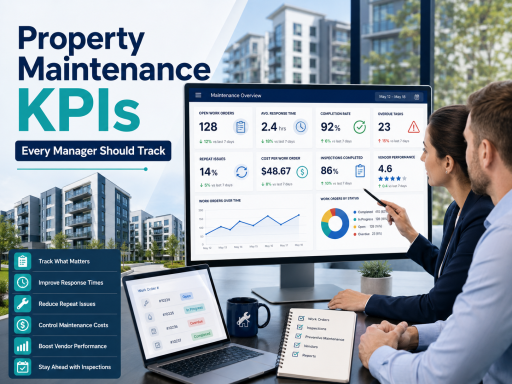
Property maintenance KPIs help managers understand how efficiently maintenance requests, work orders, inspections, vendors, and repairs are being handled across their portfolio.
Without clear maintenance tracking, property teams often rely on emails, spreadsheets, and memory to understand what is open, overdue, completed, or costing too much. The right KPIs turn daily maintenance activity into measurable insight.
Why Maintenance KPIs Matter for Property Managers
Property managers handle a constant flow of resident maintenance requests, vendor updates, work order assignments, inspections, and repair follow-ups. When those tasks are not measured, it becomes difficult to know whether the team is improving or falling behind.
A strong property maintenance software system should help managers monitor performance, identify bottlenecks, reduce delays, and improve accountability. Instead of only asking whether the work was completed, managers should also ask how quickly it was handled, who completed it, what it cost, and whether the same problem keeps returning.
Related TaskEstate Solutions
1. New Maintenance Requests
This KPI tracks how many maintenance requests are submitted during a selected period. It helps property managers understand demand by property, building, unit, category, or issue type.
A sudden increase in requests may point to aging assets, poor preventive maintenance, seasonal issues, resident communication problems, or recurring building system failures.
2. Open Work Orders
Open work orders show how much active maintenance work is currently waiting for action. This is one of the most important KPIs for any maintenance work order software because it gives managers a real-time view of workload.
A growing number of open work orders may mean the team is understaffed, vendors are delayed, approvals are slow, or priorities are not being managed correctly.
3. Average First Response Time
First response time measures how long it takes your team to acknowledge or begin handling a maintenance request after it is submitted.
This KPI is especially important for resident satisfaction. Even when a repair cannot be completed immediately, fast communication helps residents feel that the issue has been received and is being handled.
4. Average Completion Time
Completion time measures how long it takes to finish a work order from creation to closeout. This KPI helps managers evaluate the efficiency of their maintenance workflow.
If completion time is increasing, the cause may be scheduling problems, vendor delays, parts availability, unclear assignments, or inefficient internal processes.
5. Overdue Work Orders
Overdue work orders show which maintenance tasks have passed their expected completion date. This KPI helps managers focus attention on issues that may create resident complaints, compliance risks, or property damage.
Tracking overdue work is essential for property management maintenance software because it helps teams move from reactive follow-up to proactive control.
6. Work Order Completion Rate
Completion rate compares the number of completed work orders against the number created during the same period.
A healthy completion rate shows that your team is keeping up with incoming maintenance demand. A low rate may indicate backlog growth, poor prioritization, or a lack of accountability.
7. Reopened Work Orders
Reopened work orders are tasks that were marked complete but later needed additional work. This KPI helps identify quality problems, incomplete repairs, poor vendor performance, or repeated misdiagnosis.
If the same issue is reopened often, managers should review the repair history, technician notes, vendor work quality, and asset condition.
8. Repeat Maintenance Issues
Repeat issues show whether the same unit, asset, building, or maintenance category is generating frequent requests.
This KPI is valuable for maintenance tracking software because it helps managers move beyond individual repairs and identify larger operational patterns. A recurring plumbing issue, HVAC complaint, leak, appliance failure, or electrical problem may require a long-term solution instead of repeated temporary fixes.
9. Cost per Work Order
Cost per work order measures the average expense required to complete maintenance tasks. It may include labor, vendor charges, materials, parts, and other repair-related costs.
Tracking this KPI helps property managers compare costs across properties, vendors, categories, and time periods. It also supports better budgeting and owner reporting.
10. Vendor Response and Completion Performance
For teams that rely on outside contractors, vendor performance is a critical KPI. Managers should track how quickly vendors accept, schedule, and complete assigned work.
Poor vendor performance can delay repairs, increase resident frustration, and create extra work for the management team. Measuring vendor reliability helps managers make better decisions about which vendors should continue receiving assignments.
11. Preventive Maintenance Completion
Preventive maintenance completion tracks whether scheduled maintenance tasks are finished on time. This may include HVAC filter changes, fire safety checks, roof inspections, gutter cleaning, appliance servicing, or building system reviews.
Preventive maintenance KPIs help reduce emergency repairs, extend asset life, and protect property value.
12. Inspection Findings by Property or Unit
Inspection-related KPIs help managers understand what issues are being found during property inspections, unit inspections, move-in reviews, move-out reviews, and maintenance follow-ups.
When inspection results are connected with work orders, property teams can quickly turn findings into assigned maintenance tasks instead of leaving them buried in notes or PDF reports.
13. Emergency vs. Non-Emergency Work Orders
This KPI separates urgent maintenance from routine work. If emergency work orders are increasing, it may indicate weak preventive maintenance, aging systems, poor resident reporting, or delayed repairs.
A well-managed maintenance program should reduce preventable emergencies over time.
14. Maintenance Backlog by Property
Backlog by property helps managers identify which locations need attention first. One property may have a manageable number of open work orders, while another may be developing a serious maintenance problem.
This KPI is especially useful for companies managing multiple buildings, apartment communities, or rental property portfolios.
15. Resident Maintenance Request Trends
Resident request trends show what residents are reporting most often. This can reveal common pain points such as appliance issues, HVAC complaints, leaks, pest concerns, lighting problems, or access-related maintenance.
Understanding request trends helps managers improve service, plan capital improvements, and communicate more effectively with residents.
How TaskEstate Helps Track Maintenance KPIs
TaskEstate helps property managers organize maintenance requests, convert them into work orders, assign tasks, monitor statuses, document completion, and review reporting data in one workflow.
Instead of manually building reports from scattered emails and spreadsheets, teams can use structured maintenance data to understand workload, performance, delays, recurring issues, and operational risk.
Final Thoughts
The best property maintenance KPIs are not just numbers. They help managers make better decisions. By tracking requests, response time, work order completion, costs, vendor performance, inspections, and repeat issues, property teams can improve service quality and reduce operational confusion.
For growing property management companies, maintenance reporting is no longer optional. It is one of the clearest ways to improve accountability, protect assets, and deliver a better resident experience.