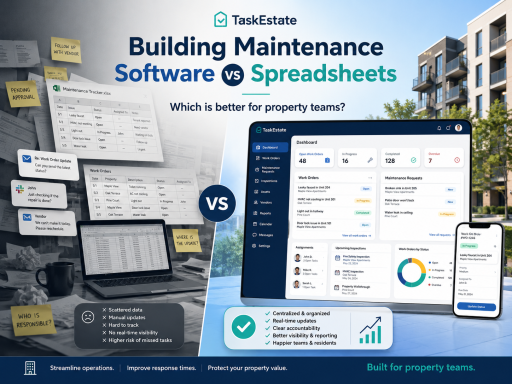
Spreadsheets can help property managers organize simple maintenance lists, but they quickly become difficult to manage when work orders, resident requests, vendors, inspections, and reporting all need to stay connected.
TaskEstate gives property teams a more structured way to manage building maintenance, maintenance tracking, work order workflows, and property maintenance operations without relying on scattered files or manual updates.
Why Property Teams Outgrow Maintenance Spreadsheets
Many property management teams start with spreadsheets because they are familiar, inexpensive, and easy to customize. A spreadsheet may be enough when a manager is tracking a few maintenance tasks across one small property.
The problem begins when the maintenance process becomes more active. As requests increase, teams need to know who submitted the issue, which unit is affected, who is assigned, what the status is, when the task was updated, whether a vendor is involved, and whether the work has been completed.
At that point, spreadsheets become a fragile maintenance tracking system. They require manual updates, offer limited accountability, and make it harder to connect resident requests with work orders, inspections, assets, and reports.
What Building Maintenance Software Does Differently
Building maintenance software is designed to manage maintenance activity as an operational workflow, not just a static list. Instead of storing repair notes in rows and columns, property teams can organize requests, create work orders, assign tasks, track progress, and review maintenance history in one system.
For property managers, this creates a more reliable way to manage building maintenance across properties, buildings, units, vendors, staff members, and recurring maintenance needs.
| Maintenance Need | Spreadsheets | Building Maintenance Software |
|---|---|---|
| Resident requests | Usually copied manually from email, phone calls, or messages | Requests can be captured and organized in a structured workflow |
| Work orders | Tracked as rows with limited status control | Created, assigned, updated, and completed with clear accountability |
| Maintenance tracking | Depends on manual updates and spreadsheet discipline | Provides a clearer record of status, assignments, dates, and history |
| Reporting | Requires manual filtering, formulas, and cleanup | Helps teams review backlog, completion activity, response trends, and workload |
| Team visibility | Files can become outdated or duplicated | Centralizes maintenance activity so teams work from the same information |
The Hidden Cost of Spreadsheet-Based Maintenance Tracking
A spreadsheet may look free, but the real cost appears in missed updates, delayed repairs, duplicate entries, unclear responsibility, and time spent searching for the latest information.
When a maintenance coordinator has to check emails, update a spreadsheet, message a technician, call a vendor, and manually report progress to a manager, the process becomes slow and difficult to audit.
TaskEstate helps reduce this manual work by keeping property maintenance information organized around the actual workflow: request, review, work order, assignment, status update, completion, and reporting.
When Spreadsheets May Still Work
Spreadsheets can still be useful for simple lists, one-time exports, budget planning, or offline notes. They are flexible and familiar, which makes them helpful for certain administrative tasks.
However, when your team needs ongoing maintenance work order software, maintenance request tracking, property management maintenance software, or building maintenance reporting, spreadsheets usually become too limited.
When to Move From Spreadsheets to Maintenance Software
Property teams should consider switching to building maintenance software when maintenance tasks are no longer easy to monitor manually. This is especially true when multiple people are responsible for updates or when several properties are being managed at the same time.
You Have Too Many Open Tasks
If open maintenance items are difficult to review, prioritize, or assign, a spreadsheet is no longer enough.
Your Team Needs Better Accountability
If it is unclear who is responsible for each repair, software can help create a clearer maintenance record.
Requests Come From Multiple Sources
Resident emails, phone calls, texts, and staff notes are hard to control unless they become part of one process.
Reports Take Too Long
If maintenance reporting requires cleanup, formulas, and manual review, your system is costing time.
How TaskEstate Helps Replace Spreadsheet Maintenance Tracking
TaskEstate is built for property maintenance teams that need a practical system for organizing resident requests, work orders, inspections, assets, and maintenance reporting.
Instead of managing maintenance through disconnected spreadsheet tabs, TaskEstate helps property managers keep the workflow connected by property, building, unit, category, status, assignee, and completion history.
Explore TaskEstate Maintenance Solutions
These TaskEstate landing pages explain the core workflows that help property teams move beyond spreadsheets:
Building Maintenance Software Is Better for Growing Teams
Spreadsheets are easy to start with, but they are not designed to manage the full maintenance lifecycle. As a property portfolio grows, the maintenance process needs stronger structure, better visibility, and more reliable documentation.
Building maintenance software gives property teams a more professional way to manage maintenance work, reduce confusion, and improve operational control across properties.
For property managers who want fewer manual updates and better maintenance visibility, TaskEstate provides a focused alternative to spreadsheet-based tracking.
Software Helps Track
- • Maintenance requests
- • Work orders
- • Assignments
- • Status updates
- • Vendors
- • Inspections
- • Maintenance history
Spreadsheets Struggle With
- • Real-time updates
- • Accountability
- • Duplicate records
- • Work order history
- • Reporting accuracy
- • Multi-property tracking


