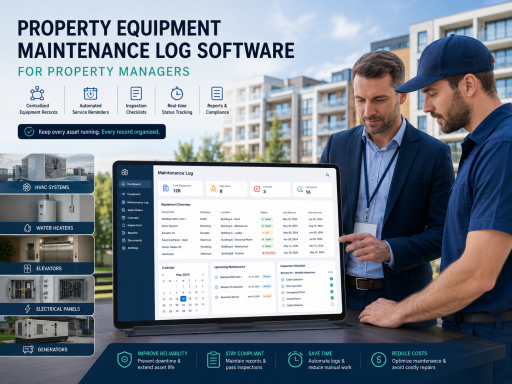
Property equipment maintenance log software helps property managers track equipment details, service history, repairs, inspections, and related work orders in one centralized system instead of relying on spreadsheets, paper logs, emails, or scattered notes.
Why Equipment Maintenance Logs Matter for Property Managers
Every property depends on equipment that needs regular attention: HVAC units, water heaters, appliances, pumps, garage systems, laundry equipment, access control hardware, lighting systems, fire-safety components, and other building assets. When these records are not organized, maintenance teams lose time searching for serial numbers, installation dates, prior repairs, warranty details, and service notes.
A structured equipment maintenance log gives managers a clear operational record for each asset. Instead of asking who repaired an item last time or when a unit was installed, the team can review the equipment history, connect it to the right property or unit, and make faster decisions about repair, replacement, inspection, and follow-up work.
TaskEstate gives property managers a practical way to organize maintenance activity across requests, work orders, inspections, buildings, units, and equipment records. You can review the full platform capabilities on the TaskEstate features page.
What Is Property Equipment Maintenance Log Software?
Property equipment maintenance log software is a digital system used to record and manage equipment-related maintenance information across rental properties, apartments, multifamily buildings, commercial spaces, and managed portfolios.
A good maintenance log should help your team answer questions such as:
- Where is this equipment located?
- Which property, building, or unit does it belong to?
- When was it installed?
- What is the equipment type, model, or serial number?
- What maintenance has already been completed?
- Which work orders are connected to this equipment?
- Are there repeated problems with the same asset?
- Should the item be repaired again or replaced?
This is especially useful for property managers who need better visibility across multiple properties, multiple buildings, and many units. A simple spreadsheet may work for a few records, but it becomes hard to manage when maintenance requests, inspections, and work orders start growing.
Track Equipment by Location
Equipment records should be tied to the correct property, building, unit, or shared area. This helps maintenance teams quickly understand where the asset is located and what operational context applies to it.
Keep Maintenance History Organized
A digital log helps preserve service notes, repair history, recurring issues, installation dates, and related work activity so your team does not lose important information when staff changes or vendors rotate.
Connect Equipment to Work Orders
When equipment problems become actionable tasks, managers need a clear workflow from issue identification to assignment, completion, and documentation.
Improve Repair vs. Replacement Decisions
Repeated repairs on the same equipment can signal that replacement may be more cost-effective. Maintenance logs help managers identify patterns instead of treating every repair as an isolated event.
From Equipment Records to Complete Maintenance Operations
Equipment maintenance logs are most useful when they are connected to the rest of the property maintenance workflow. TaskEstate helps property teams move beyond isolated asset lists by connecting equipment history with requests, work orders, inspections, and property structure.
Explore Property Maintenance SoftwareCommon Problems with Manual Equipment Maintenance Logs
Many property managers start with spreadsheets or paper forms because they are simple. The problem is that equipment maintenance becomes more complicated as the portfolio grows. Manual records are easy to forget, duplicate, misplace, or update incorrectly.
| Manual Log Problem | Operational Impact | Better Software Approach |
|---|---|---|
| Records stored in different spreadsheets | Managers cannot quickly verify equipment history | Centralized equipment and maintenance records |
| No connection to work orders | Repairs become hard to trace after completion | Link equipment issues to assigned work orders |
| Missing location details | Technicians waste time confirming where the asset is located | Organize equipment by property, building, unit, or shared area |
| No inspection follow-up | Deficiencies may be documented but not resolved | Turn inspection findings into trackable maintenance actions |
| No repeat-issue visibility | Managers may keep repairing equipment that should be replaced | Review maintenance history before approving repairs |
How TaskEstate Supports Equipment Maintenance Logs
TaskEstate is designed for property maintenance operations where requests, work orders, inspections, properties, buildings, units, and equipment records need to work together. Instead of managing equipment logs separately from daily maintenance activity, teams can keep records connected to real operational workflows.
Resident-Reported Equipment Issues
When residents report issues with appliances, fixtures, HVAC, access systems, or other equipment, managers need a structured intake process. TaskEstate helps teams organize incoming issues through resident maintenance requests.
Work Orders for Repairs and Service
Equipment problems often require assignment, scheduling, updates, completion notes, and accountability. TaskEstate supports this workflow through work order management.
Inspection-Driven Follow-Up
Equipment problems are not always reported by residents. They may be discovered during move-in checks, routine property walks, safety reviews, or unit inspections. TaskEstate helps teams document findings with property inspections.
Equipment Logs Should Follow Your Property Structure
A maintenance log becomes more valuable when every record is tied to the right location. For example, a water heater may belong to a specific unit, while a boiler, gate motor, or hallway lighting system may belong to a building or common area. Without a consistent property structure, equipment records become difficult to search and maintain.
TaskEstate helps organize maintenance context through property, building, and unit management, making it easier to connect equipment records with the correct operational location.
Who Benefits from Equipment Maintenance Log Software?
Equipment maintenance tracking is useful for any property operation that needs clearer records, faster coordination, and better accountability. It is especially valuable for:
- Property managers overseeing multiple buildings or units
- Maintenance supervisors coordinating recurring repairs
- Apartment communities with shared building systems
- Portfolio managers reviewing maintenance costs and trends
- Inspection teams documenting equipment conditions
- Owners who want better visibility into asset condition and service history
- Vendors and technicians who need accurate equipment context before arriving onsite
Key Features to Look For
When choosing property equipment maintenance log software, look for a system that does more than store basic asset names. The strongest solution should connect equipment records to the daily maintenance process.
Track asset name, type, location, serial number, installation date, and status.
Keep service records, repair notes, completed work orders, and recurring issues organized.
Create and manage repair tasks connected to equipment problems.
Document equipment issues during inspections and move them into action.
Tie each asset to the right building, unit, or shared area.
Help managers understand what was repaired, where, when, and by whom.
Better Equipment Records Lead to Better Maintenance Decisions
Property managers need more than a list of equipment. They need a maintenance record that supports daily operations, resident service, vendor coordination, inspection follow-up, and long-term planning. When equipment logs are connected to work orders and property structure, the team gains a more complete view of maintenance activity.
This helps reduce repeated troubleshooting, improve response time, preserve historical records, and support more professional maintenance operations across the portfolio.
Move from Spreadsheets to a Connected Maintenance Platform
TaskEstate helps property managers organize equipment records, maintenance requests, work orders, inspections, and property structure in one operational system.
See How TaskEstate Helps

