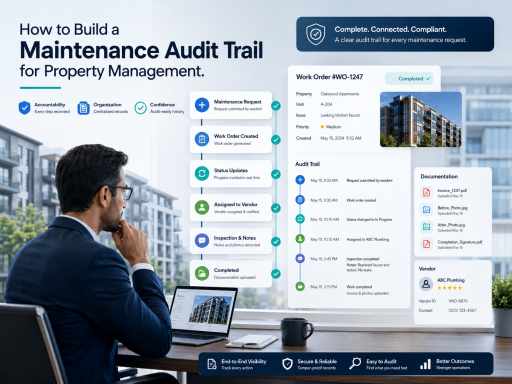
A maintenance audit trail gives property managers a clear record of what was reported, who reviewed it, who completed the work, when the status changed, and how the issue was resolved.
For apartment communities, rental portfolios, and commercial properties, a strong audit trail helps reduce confusion, improve accountability, and support better maintenance decisions across every property.
Explore Property Maintenance SoftwareWhat Is a Maintenance Audit Trail?
A maintenance audit trail is a documented history of each maintenance issue from the first request to final completion. It shows the full path of the issue, including request details, approval steps, work order activity, staff or vendor assignment, inspection results, and final notes.
Without a reliable audit trail, property teams often depend on emails, phone notes, spreadsheets, or memory. That can create gaps when a resident asks for an update, a manager reviews performance, or an owner wants proof that work was handled properly.
Why Property Managers Need a Maintenance Audit Trail
Property management maintenance software helps teams keep maintenance records organized instead of scattered across separate tools. A clear audit trail makes it easier to answer important operational questions.
- When was the maintenance request submitted?
- Who reviewed or approved the request?
- Was the issue converted into a work order?
- Who was assigned to complete the work?
- When did the status change?
- Was an inspection completed after the repair?
- What notes, costs, or follow up actions were recorded?
Start With a Structured Maintenance Request
A strong audit trail begins when the issue is first reported. The maintenance request should include the property, building, unit, resident contact details, issue category, description, priority, access notes, and submission date.
Using a structured request process helps property teams avoid missing details. It also gives managers a better starting point before creating a work order, assigning staff, or contacting a vendor.
TaskEstate helps property teams organize incoming requests through a dedicated maintenance request workflow. Learn more about resident maintenance requests.
Convert Requests Into Trackable Work Orders
Once a request is reviewed, the next step is to create a work order. This is where maintenance work order software becomes important. A work order should include the task description, assignment, priority, due date, scheduled date, vendor details when needed, and current status.
Connecting the original request to the work order gives managers a complete record. Instead of seeing only the final repair task, the team can also see what triggered the work, who submitted it, and how the issue moved through the maintenance process.
For teams that manage multiple properties, this connection is essential. It helps prevent duplicate work, missed updates, and unclear responsibility.
Track Every Status Change
Maintenance tracking software should record status changes clearly. Common status points include new, reviewed, approved, scheduled, in progress, waiting, completed, and closed.
These updates help managers understand how long work takes, where delays happen, and which requests need attention. Status history is also useful when residents, owners, or supervisors ask for a clear explanation of what happened.
Example Audit Trail Flow
- Resident submits a maintenance request
- Manager reviews the request details
- Request is approved or assigned for action
- Work order is created and scheduled
- Technician or vendor updates the status
- Repair is completed with notes
- Inspection or final review is recorded
Add Assignment and Vendor Records
An audit trail should show who was responsible for each task. This includes internal maintenance staff, outside vendors, supervisors, and managers who reviewed or approved work.
For vendor related work, the record should include vendor name, scheduled service date, completion notes, cost details, and any follow up requirements. This gives property managers a better record for accountability, budgeting, and future vendor review.
Use Inspections to Verify Completion
Maintenance inspection software adds another layer of proof to the audit trail. After important repairs, turnovers, safety items, or recurring issues, an inspection can confirm that the work was completed correctly.
Inspection notes help document condition, quality, and next steps. They are especially useful for apartment maintenance, building maintenance, commercial property maintenance, and rental property maintenance records.
TaskEstate supports inspection based workflows for property teams. Review the property inspections feature.
Measure Performance With Maintenance Reports
A maintenance audit trail is more than a record. It becomes useful data for maintenance reporting software. Managers can review response times, completion rates, open work orders, recurring issues, vendor workload, and property level performance.
These reports help property managers identify slowdowns, improve maintenance planning, and make better decisions across the portfolio.
TaskEstate includes reporting tools for property maintenance operations. See maintenance dashboard reporting.
Avoid Common Audit Trail Mistakes
Many property teams try to create an audit trail manually, but gaps appear when updates are stored in too many places. The most common problems include missing request details, unclear approvals, unassigned work orders, incomplete status history, no inspection record, and no final completion notes.
A better process keeps every part of the maintenance lifecycle connected. The original request, work order, assignment, inspection, and report should all support one clear operational record.
Build a Better Maintenance Record With TaskEstate
TaskEstate helps property managers organize maintenance requests, work orders, inspections, assets, and reporting inside one property maintenance system. This gives teams a clearer way to manage daily repairs and create a stronger maintenance audit trail.
Whether your team manages apartment maintenance, rental property maintenance, building maintenance, or commercial property maintenance, an organized audit trail helps improve accountability and reduce operational risk.
Who Benefits
- Property managers
- Maintenance coordinators
- Apartment operators
- Rental property teams
- Commercial property teams