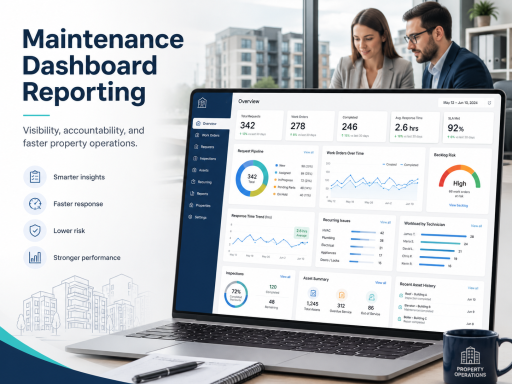
Maintenance performance is one of the most visible indicators of property operations quality. Owners want confidence that resident issues are addressed quickly, budgets are controlled, assets are protected, and compliance risk is managed. The challenge is that many maintenance “reports” are stitched together from emails, phone logs, and spreadsheets—making results hard to trust and hard to compare across properties.
This article outlines the owner-ready maintenance metrics that matter most, how to define them consistently, and how to report them by unit, building, and property. A reliable reporting program depends on two foundational elements: structured work execution and portfolio-wide analytics. TaskEstate supports that foundation with property maintenance software and maintenance dashboards and reporting that replace manual tracking with a centralized system of record.
Why owners care about maintenance reporting
Owners do not just want activity summaries; they want operational proof. Strong reporting helps answer questions that directly affect NOI, retention, and risk:
- Service quality: Are residents receiving timely responses and consistent outcomes?
- Operational control: Is work being approved, assigned, and closed out with accountability?
- Cost management: Are recurring issues driving repeat labor and vendor spend?
- Risk and compliance: Are inspections documented and follow-ups completed?
- Portfolio comparability: Which properties are improving, and which require intervention?
A reporting program becomes meaningful when it is based on consistent workflows—starting with work order management that captures the same data fields, statuses, and outcomes across the portfolio.
Define a standard reporting model before you publish metrics
Most reporting issues are definition issues. Before you show owners charts, ensure your organization uses shared definitions for “response time,” “completion,” “backlog,” and “repeat work.” Standardization enables apples-to-apples comparisons across properties and eliminates debates over what the numbers mean.
A practical model includes:
- Intake channel and timestamp: when the issue was submitted (structured intake helps).
- Approval timestamp: when work was authorized (where approvals are required).
- Assignment timestamp: when the work order was assigned to a technician or vendor.
- Status progression: consistent statuses with notes (open, in progress, waiting, completed).
- Closeout evidence: completion notes and outcomes, plus inspection verification when applicable.
Reliable intake begins with a consistent resident request workflow, supported by the resident maintenance requests portal, so the data owners see is rooted in a complete and structured request record.
The owner-ready metrics that prove maintenance performance
Not every internal KPI should be shared with owners. Owner reporting should emphasize service levels, trend signals, and risk controls. Below are the metrics that typically create the strongest operational narrative.
1) Response time
Definition: Time from resident submission to first meaningful action (acknowledgment, triage, or assignment—depending on your standard).
Why it matters: Response time is the earliest indicator of resident experience and operational control. Owners often see response time as a leading indicator of retention risk and escalation risk.
2) Time to approve (where applicable)
Definition: Time from request submission to manager approval.
Why it matters: Approval delays often create downstream backlog and longer completion times. Owners want confidence that governance exists without slowing routine work.
3) Time to complete
Definition: Time from work order creation (or approval) to completion.
Why it matters: Completion time reflects staffing capacity, process friction, and vendor responsiveness. It is also the metric most associated with repeat resident complaints.
4) Backlog and aging
Definition: Count of open work orders and the distribution of how long they have been open.
Why it matters: Backlog is the operational pressure gauge. Owners care about aging because older work orders signal service risk, potential habitability concerns, and higher escalation probability.
5) First-time fix rate (or “repeat within X days”)
Definition: Percentage of work orders resolved without a repeat request for the same issue within a defined window (e.g., 14–30 days).
Why it matters: Repeat work is hidden cost: extra labor, extra parts, extra visits, and higher dissatisfaction. Owners view repeat patterns as a quality signal, not just volume.
6) Recurring issues by location
Definition: Work order frequency by unit/building/property for the same category or asset class.
Why it matters: Location-based recurrence helps owners target capital planning and prioritize interventions. This reporting depends on clean portfolio structure, supported by property, building, and unit management, so maintenance activity can be analyzed at the right level of detail.
7) Inspection outcomes and follow-up completion
Definition: Inspection pass/fail rates (or outcomes), plus follow-up work order creation and completion rates.
Why it matters: Owners want evidence that quality is verified and risk is controlled. Inspections provide an audit-friendly record and reduce disputes over whether work was truly completed. Inspection outcomes are best managed through property inspection software.
8) Work mix: emergency vs routine
Definition: Volume and completion trends for high-priority/emergency issues versus routine maintenance.
Why it matters: A high emergency mix can indicate aging assets, resident misuse, or inadequate preventive maintenance. Owners use this to understand risk posture and staffing needs.
Properties/Units ↔ Assets ↔ Reporting: how to build owner-grade insights
Owners value insights that explain why maintenance volume and cost behave the way they do. Two data connections dramatically improve reporting quality:
- Location context: work history by unit, building, and property
- Asset context: installation and lifecycle history tied to recurring work
Asset context is especially powerful for owner communications. When you can link recurring requests to a specific asset class and installation timeline, you can justify repair-versus-replace decisions with evidence. That lifecycle view is supported through asset installation records, which strengthen replacement planning and reduce repeat diagnostics.
Work Orders ↔ Reporting ↔ Inspections: the closed-loop model owners trust
Owners trust reporting when it reflects a disciplined operational loop:
- Requests are submitted consistently and routed into a controlled process.
- Work is approved (when needed), assigned, executed, and closed out with documentation.
- Inspection verification confirms outcomes for quality and compliance-sensitive work.
- Dashboards and trends highlight bottlenecks, recurring issues, and performance improvements.
This closed-loop approach reduces subjective updates and turns owner conversations into measurable operations. It also makes variance explainable: when completion time rises, you can identify whether the driver is intake quality, approvals, staffing capacity, vendor dependency, or inspection follow-ups.
Permissions and governance: keep reporting credible
Owner reporting is only as credible as the underlying data. A practical governance model assigns responsibility for approvals, updates, and closeouts so metrics reflect reality rather than inconsistent user behavior.
Role-based controls help ensure that the right people perform the right actions (and that the audit trail remains trustworthy). For teams that need clear accountability between managers, technicians, inspectors, and administrators, TaskEstate supports governance through user and role management.
How to present maintenance reports to owners
Owners typically prefer reporting that is consistent, comparable, and action-oriented. A strong monthly or quarterly package includes:
- Executive summary: what improved, what declined, and why
- Service levels: response time, completion time, backlog aging
- Quality signals: repeat rate, inspection outcomes and follow-ups
- Top drivers: recurring issue categories, locations, asset trends
- Action plan: staffing shifts, vendor actions, preventive maintenance, replacement proposals
The goal is not to overwhelm owners with data. The goal is to provide proof of performance and a clear operational plan for improvement—supported by dashboards that are grounded in standardized workflows.
Next step: turn owner reporting into a competitive advantage
When maintenance reporting is consistent and portfolio-aware, it becomes more than a monthly deliverable—it becomes an operating system that improves response time, reduces repeat work, and builds owner confidence. If your reporting still depends on manual rollups, the fastest path to improvement is centralizing requests, work orders, inspections, asset history, and analytics into one system.
To review packages and select the right fit for your portfolio, visit pricing.
FAQ
What maintenance metrics do owners care about most?
Owners typically prioritize response time, completion time, backlog aging, repeat work signals, and inspection outcomes because these metrics translate directly into resident satisfaction, cost control, and risk management.
How do you report maintenance performance by unit, building, and property?
Location-based reporting requires a structured portfolio model so every request and work order is tied to the correct unit/building/property. With that foundation, trends and recurring issues can be analyzed at the right level of detail.
How do inspections improve the credibility of owner reporting?
Inspections provide verification that work was completed to standard, document outcomes for compliance-sensitive items, and create a clear record for follow-up actions. This reduces disputes and strengthens accountability.