Recurring maintenance requests are rarely “bad luck.” They are signals—of aging assets, incomplete closeouts, inconsistent diagnostics, or building-level conditions that keep producing the same failures. For property managers, repeats create an expensive loop: more technician time, more resident frustration, and less confidence in operational control.
The fastest way to reduce repeat incidents is to treat maintenance data as operational intelligence. When requests, work orders, inspections, and asset records are structured and connected to a location, you can identify patterns by unit and building, prevent repeat failures, and improve response time portfolio-wide.
Why repeat issues happen in the first place
Repeat work is often a symptom of process gaps rather than technician effort. Common causes include:
- Unstructured intake: requests arrive with incomplete details, leading to misdiagnosis and return visits.
- Inconsistent work order documentation: closeout notes don’t capture root cause or the fix performed.
- Location ambiguity: repairs are not reliably tied to the exact unit or building, obscuring patterns.
- No verification loop: work is marked “complete” without inspection or quality confirmation.
- Missing asset context: teams repeatedly repair components that should be replaced based on age or history.
The solution is not “more effort.” It is a workflow that creates clean data at every step—so repeats can be detected early and addressed systematically using a centralized property maintenance platform.
Step 1: Standardize work orders so the data becomes usable
If work order fields and statuses are inconsistent, reporting will be inconsistent. To spot repeats, you need structured records: issue type, priority, location, timestamps, and a closeout narrative that describes the actual fix.
A structured workflow begins with work order management software that standardizes request-to-completion steps and preserves an audit trail. This is the foundation for repeat detection because it makes the “what happened” and “where it happened” reliable.
Practical standardization rules that reduce repeats:
- Use consistent categories (e.g., plumbing leak, HVAC no-cool, electrical outlet, appliance failure).
- Require closeout notes that include root cause, parts used, and verification performed.
- Use consistent statuses (e.g., New, Approved, Assigned, In Progress, Completed, Verified).
- Capture “return visit required” as a structured flag, not just a note.
Step 2: Tie every record to the correct unit and building
Recurring issues rarely reveal themselves at a portfolio level. They appear as clusters: a specific unit with repeated plumbing clogs, a building with repeated electrical complaints, or a floor with recurring HVAC problems. If you cannot reliably group work by location, you cannot see the pattern.
Ensure your operational structure is explicit and consistent using property, building, and unit management. When location is a first-class field, you can answer high-value questions:
- Which units have the most repeat work orders over the last 90 days?
- Which buildings produce the highest volume of the same category (e.g., leaks, HVAC calls)?
- Are repeats concentrated around a specific renovation batch or wing?
Step 3: Improve intake quality to reduce misdiagnosis
Repeat incidents often start with low-quality intake: unclear symptom descriptions, missing photos, or vague “not working” requests that lead to incomplete repairs. Better intake reduces repeat visits because technicians arrive with enough context to diagnose correctly the first time.
A structured resident request portal helps standardize what information is captured upfront. Over time, that improves both repair quality and the accuracy of the reporting signals you rely on to detect patterns.
Step 4: Use reporting to surface repeat clusters by unit and building
Once work orders and locations are structured, the next step is turning activity into insight. The goal is to surface repeat patterns early—before they become resident escalations or expensive multi-visit cycles.
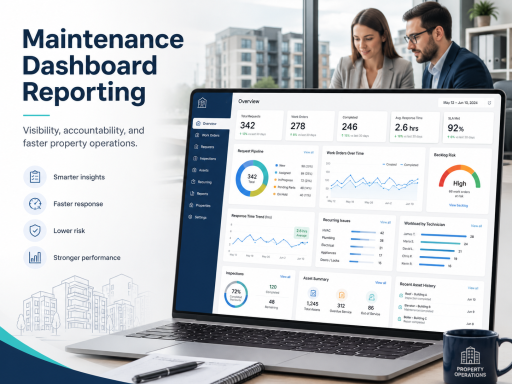
Use maintenance dashboards and reporting to monitor:
- Repeat rate: percentage of work orders reopened or repeated within 30/60/90 days.
- Top repeat units: units with the highest number of repeat work orders in a defined period.
- Building hot spots: buildings with repeated categories (e.g., plumbing, HVAC, pests).
- Category recurrence: issue types that recur disproportionately in specific locations.
- Time-to-close vs. repeat: short closures that correlate with higher repeat frequency.
Operationally, this is where patterns become actionable: you can schedule targeted inspections, initiate preventive work, or coordinate vendor assessments for specific buildings or systems.
Step 5: Close the loop with inspections to verify quality
A common repeat driver is “paper completion” without verification. Inspections provide quality control and documentation—especially for recurring issue categories where incomplete fixes cause repeated requests.
With property inspections, teams can record findings, confirm resolution, and trigger follow-up actions when needed. This creates the closed-loop relationship that reduces repeats:
- Work order completed
- Inspection verifies outcome (as required)
- Follow-up work created if the underlying issue persists
- Reporting captures repeats and verifies improvement over time
Step 6: Add asset history to distinguish “fix” problems from “replace” problems
Some repeats are not process failures—they are lifecycle failures. A water heater at end-of-life will keep generating problems, even with competent repairs. That’s why recurring issue analysis should include asset context.
Use asset installation records to connect maintenance history to what was installed, where, and when. This enables better decisions:
- Identify assets producing repeat incidents beyond an acceptable threshold
- Compare repeat frequency against install date or expected lifespan
- Support repair-versus-replace decisions with evidence
- Plan preventive replacements by building or renovation cohort
Step 7: Assign accountability with roles and permissions
Repeat reduction requires consistent execution: standardized closeout notes, consistent inspection procedures, and disciplined reporting review. That only works when responsibilities are clear and the right people have the right access.
Implement governance and operational clarity with user and role management, ensuring managers, maintenance staff, and inspectors can perform their functions without creating permission bottlenecks or process workarounds.
A practical repeat-issue playbook for property managers
To operationalize this approach, apply a simple monthly cadence:
- Review top repeat units and buildings in reporting for the last 30–60 days.
- Identify the top repeating categories and confirm documentation quality in closeout notes.
- Schedule targeted inspections for the top clusters to verify outcomes and detect root causes.
- Check asset age and history for recurring systems; decide repair vs. replace.
- Implement corrective actions (preventive work, vendor assessment, replacement plans).
- Measure improvement by tracking repeat rate over the next cycle.
This process reduces repeat volume, improves resident experience, and allows maintenance teams to spend more time on net-new work instead of return visits.
Next step
If you are ready to reduce repeat work orders and improve response time with one centralized platform, review plans and get started on the TaskEstate pricing page.
FAQ
What is the best way to identify recurring maintenance issues?
Start by standardizing work order categories and closeout notes, then analyze repeats by unit and building. Use dashboards to flag top repeat locations and categories, and validate outcomes with inspections where needed.
Why do recurring issues often cluster in one building?
Building-level conditions such as shared plumbing lines, aging mechanical systems, renovation quality, or environmental factors can create recurring categories. Location-based reporting helps confirm whether the pattern is systemic rather than isolated.
How do asset records help reduce repeat work orders?
Asset records provide lifecycle context—what was installed, where, and when—so teams can recognize when repeat repairs indicate end-of-life replacement rather than continued reactive fixes.