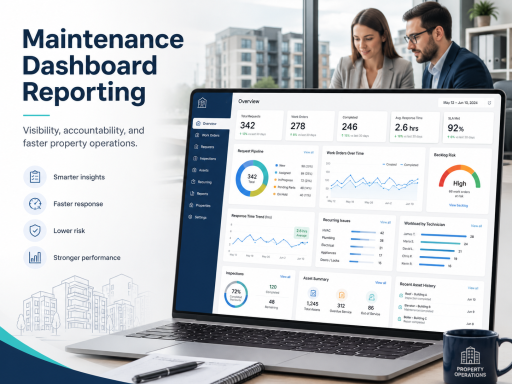
Property maintenance performance rarely improves because teams “work harder.” It improves when managers can see what is happening, identify bottlenecks early, and enforce consistent execution across properties. That requires the right KPIs—tracked the same way, every day—inside a single operating system for maintenance.
TaskEstate centralizes requests, approvals, work orders, inspections, asset records, and reporting so property managers can replace emails and spreadsheets with measurable workflows. If you want the full platform view, start with property maintenance software.
Why KPIs Fail in Property Maintenance
Many maintenance KPI programs fail for predictable reasons: metrics are inconsistent, data entry varies by team member, and reporting is created after the fact—usually to explain a problem rather than prevent one. The fix is not “more reports.” The fix is choosing a small set of operational KPIs that connect directly to decisions property managers make each week.
The KPIs below are designed to do three things: reduce response time, increase accountability, and surface recurring issues before they become portfolio-wide problems.
The KPI Set That Moves Response Time
1) Time to First Touch
Definition: Time from resident submission to the first meaningful action (review, approval, assignment, or staff contact—whatever your operation treats as “in progress”).
Why it matters: This metric is the earliest indicator of responsiveness. If it slips, resident dissatisfaction rises quickly.
How to improve it: Standardize intake so requests arrive with the information needed to route quickly. A dedicated intake flow via the
resident maintenance requests portal
reduces clarification loops that delay first touch.
2) Approval Cycle Time
Definition: Time from request creation to approval (for workflows that require manager sign-off).
Why it matters: Approvals are a common hidden bottleneck—especially in multi-property portfolios where managers juggle competing priorities.
How to improve it: Clarify what requires approval, set thresholds, and ensure the right people have the authority to approve consistently.
3) Assignment Time
Definition: Time from approval to assignment to a maintenance staff member (or vendor).
Why it matters: Assignment time reveals operational discipline. When it grows, it typically points to unclear ownership, poor triage rules, or overloaded teams.
How to improve it: Use a consistent work order workflow that standardizes the handoff from approval to execution through
work order management.
4) Completion Time (Cycle Time)
Definition: Time from assignment to completion (or from request to completion, if you prefer end-to-end).
Why it matters: Completion time impacts resident experience and operational cost. It also influences backlog growth.
How to improve it: Break cycle time into stages (waiting, in progress, parts needed, vendor scheduled) so delays are visible and fixable.
The KPI Set That Creates Accountability
5) Backlog Size and Backlog Aging
Definition: Count of open work orders plus the number that exceed your aging thresholds (e.g., 3, 7, 14 days).
Why it matters: Total backlog alone can be misleading; aging shows where service levels are breaking down.
How to improve it: Set aging rules by priority (emergency vs routine) and enforce weekly backlog review.
6) Reopen Rate and Repeat Work
Definition: Percentage of work orders reopened or repeated for the same issue within a defined window (e.g., 30–60 days).
Why it matters: Repeat work is one of the highest-cost failure modes in maintenance. It consumes labor and damages trust.
How to improve it: Use quality verification and clear close-out standards, especially for high-impact repairs.
7) Status Compliance (Workflow Discipline)
Definition: Percentage of work orders updated to the correct status with required notes within defined time windows.
Why it matters: If status data is unreliable, reporting becomes unreliable—and managers revert to chasing updates manually.
How to improve it: Establish minimum documentation standards for transitions (e.g., “Completed” requires notes and resolution summary).
8) Workload Balance
Definition: Work orders assigned and completed per technician (or vendor), adjusted for priority and complexity if possible.
Why it matters: Uneven load distribution increases cycle time and causes inconsistent resident experiences across buildings.
How to improve it: Use role clarity and permissions so assignments and ownership are consistent across teams through
user and role management.
Reporting + Inspections: How to Measure Quality, Not Just Speed
Speed without quality creates a vicious cycle: tickets close quickly, then reopen, then become escalations. To prevent that, reporting must connect outcomes to verification.
A practical quality KPI is inspection verification rate (where inspections apply): the percentage of completed work orders that are verified as acceptable on first review. Another is inspection-driven follow-up rate, which highlights recurring workmanship issues or unclear work order scopes.
Build this closed-loop discipline by tying reporting to property inspections so the KPI program measures outcomes, not activity.
Properties/Units + Assets + Reporting: Find Recurring Issues Faster
The most actionable maintenance insights come from location and asset context. Reporting becomes dramatically more valuable when trends can be analyzed by unit, building, and property—then connected to specific assets.
To enable that, standardize your portfolio structure using property, building, and unit management. Then add lifecycle context with asset installation records so recurring work can be evaluated as a lifecycle problem—not just an isolated ticket.
Operational Dashboard Cadence: How Property Managers Should Use KPIs
KPIs are only helpful when they are reviewed on a consistent schedule and tied to specific operational actions. A simple cadence that works well for property managers:
- Daily: backlog aging, time to first touch, urgent work order queue
- Weekly: completion time trends, workload balance, reopen rate
- Monthly: recurring issues by property/building/unit, asset-related repeat work, inspection outcomes
TaskEstate supports portfolio visibility through maintenance dashboards and reporting, helping managers replace manual spreadsheet reporting with real-time operational control.
Next Step: Centralize KPI Tracking in One System
If your KPI reporting depends on manual exports, spreadsheet cleanup, or chasing updates across email threads, the metrics will always be late and incomplete. Centralize maintenance workflows and reporting in one platform, then enforce consistent statuses and ownership so KPIs are reliable enough to drive decisions.
For packaging and plans, review TaskEstate pricing.
FAQ
What are the most important maintenance KPIs for property managers?
Time to first touch, approval cycle time, assignment time, completion time, backlog aging, reopen rate, and workload balance. These metrics directly connect to responsiveness and accountability.
How do I reduce response time without increasing headcount?
Focus on shortening the time before work begins: improve intake quality, reduce approval delays, and standardize assignment. Then track backlog aging weekly to prevent hidden accumulation.
How do inspections improve maintenance KPI programs?
Inspections provide quality verification. When inspection outcomes are connected to work completion, you can measure first-pass quality, reduce repeat work, and identify training or scope issues.