Property managers rarely choose a single maintenance model forever. Most portfolios run a blended approach: in-house teams handle routine work and on-call response, while vendors cover specialty trades, peak demand, or cost-controlled scopes. The operational challenge is not deciding vendor versus in-house—it is maintaining consistent accountability regardless of who performs the work.
When vendor jobs are tracked in emails and PDFs while in-house work lives in a spreadsheet or a different system, you lose control over the two things that matter most: response time and traceability. The solution is a single, standardized workflow that treats every job as measurable, auditable work—whether the assignee is an employee or a third party.
The Accountability Problem: Two Workflows, Two Standards
Most maintenance organizations unintentionally create two parallel processes:
- In-house: structured assignment, informal updates, partial history.
- Vendors: unstructured quoting, scattered approvals, status updates buried in email threads.
The result is predictable: vendors feel slow because there is no shared status definition, approvals take longer because documentation is fragmented, and recurring issues are hard to diagnose because the “system of record” is spread across inboxes. A unified platform fixes this by ensuring every job follows the same lifecycle and produces the same operational data.
Centralized workflows start with a portfolio-ready foundation such as property maintenance software, where requests, approvals, work orders, inspections, asset history, and reporting live in one place.
One Workflow, Two Delivery Models
Whether work is performed by in-house staff or a vendor, the workflow should remain consistent:
- Intake: capture the request and required details.
- Review: confirm scope, priority, and location.
- Approval: authorize work (and cost) before execution.
- Assignment: route to in-house staff or vendor.
- Execution: track status, notes, and outcomes.
- Verification: inspect results when appropriate.
- Measurement: report performance and recurring issues.
A structured workflow prevents “vendor drift,” where third-party work becomes opaque and unmeasurable. It also helps internal teams by standardizing the same rules across properties and buildings—so staffing changes and portfolio growth do not break operations.
The operational backbone for this approach is a consistent work order management process that converts requests into assignable, trackable jobs with clear ownership and history.
Start Strong: Standardized Intake and Resident Experience
Vendor accountability begins at intake. If the initial request is vague, the downstream process becomes slow: vendors request more details, managers re-clarify scope, and residents receive inconsistent updates. Clean intake reduces rework and accelerates assignment.
Use a structured request flow such as a resident maintenance requests portal to capture the problem description, urgency, and location details upfront. This improves triage and makes it easier to decide whether the job is best handled by in-house staff or routed to a vendor.
Approval Discipline: Control Cost Without Creating Bottlenecks
Approval workflows are where vendor maintenance often breaks down. Quotes, estimates, and “go-aheads” bounce through email threads, then someone asks later, “Who approved this?” The fix is not more bureaucracy—it is a consistent approval checkpoint that records the decision, timestamp, and approver.
A practical approval model includes:
- Threshold rules: define when approval is required (for example, all vendor work or work above a certain scope level).
- Priority rules: emergency work can proceed while documentation follows a defined fast-track.
- Audit readiness: approvals are attached to the work record, not stored in inboxes.
This approach improves both budget control and response time, because the team stops re-litigating the same decision process on every job.
Location Precision: Tie Accountability to the Correct Unit and Building
Vendor work becomes difficult to evaluate when you cannot reliably answer: “Where did this occur?” A portfolio needs consistent structure so that work can be filtered and analyzed by unit, building, and property. This is essential for identifying repeat issues (and repeat spend).
Use a location-aware operating model supported by property, building, and unit management so every work record is attached to the right place. When the location is correct, reporting becomes actionable rather than anecdotal.
Work Orders ↔ Reporting ↔ Inspections: The Closed-Loop Standard
The fastest way to improve vendor accountability is to adopt a closed loop:
- Work Orders: every job is trackable with status and notes.
- Reporting: performance is measurable by property, unit, assignee type, and issue category.
- Inspections: outcomes are verified when the work is high-risk, high-cost, or frequently repeated.
Portfolio visibility comes from maintenance dashboards and reporting, which makes it possible to monitor workload, throughput, bottlenecks, and recurring issues across properties. This is where vendor performance becomes a management function rather than a guessing game.
Verification is supported through property inspections, which provide a structured record of outcomes and can trigger follow-up action when work does not meet standards. Inspections are especially valuable for turnover work, safety issues, and recurring complaints where “completed” does not necessarily mean “resolved.”
Properties/Units ↔ Assets ↔ Reporting: Make Repair vs Replace Decisions with Evidence
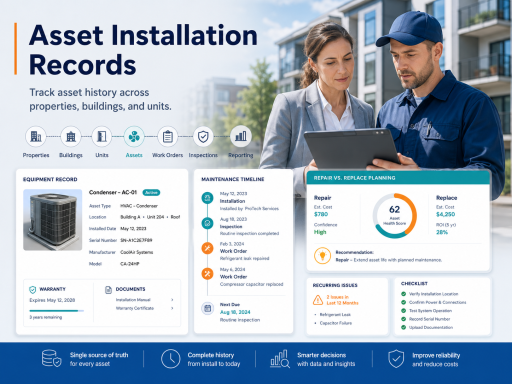
Vendor and in-house work should not only be tracked; it should inform lifecycle decisions. When the same component fails repeatedly, “another repair” may be the most expensive option. The operational improvement is linking work to asset history so you can measure repeat incidents and make repair-versus-replace decisions with confidence.
Maintain lifecycle context using asset installation records to capture what was installed, where, and when. When this is paired with reporting, property managers can identify:
- Which assets drive recurring work orders and vendor callouts
- Which buildings or unit types have higher failure rates
- Where replacement planning will reduce repeat maintenance spend
This is how maintenance shifts from reactive response to portfolio-level operational planning.
Security, Users, and Permissions: Enforce Responsibility Without Friction
Accountability requires clear responsibility boundaries. Vendors should not have broad portfolio access, and internal staff should not be blocked from executing routine work. Role-based permissions ensure the right users can perform the right actions while preserving governance.
Configure access using user and role management so property managers control approvals and oversight, maintenance staff can execute and update status, and inspectors can document outcomes independently. This reduces operational risk and strengthens audit trails.
A Practical Implementation Playbook for Property Managers
To operationalize accountability across vendor and in-house maintenance, implement in this order:
- Standardize intake: define required fields for every request (issue category, location, priority, access notes).
- Define approval rules: set thresholds and emergency exceptions; require approvals for vendor work where appropriate.
- Use consistent statuses: ensure both vendor and in-house jobs follow the same status definitions from assigned to completed.
- Require documentation: capture notes, outcomes, and completion evidence in the work record.
- Verify high-risk work: apply inspections for turnover, safety, repeat incidents, and high-cost items.
- Measure and improve: review reporting weekly to spot bottlenecks and recurring issues; adjust staffing or vendor coverage accordingly.
- Add lifecycle context: connect recurring work to asset history and plan replacement cycles based on evidence.
This playbook replaces informal coordination with a repeatable operational model. The benefit is not only speed—it is predictability and control.
Cost Control Without Losing Speed
Vendor work can feel expensive because organizations track invoices, not performance. When you measure response time, completion time, repeat incidents, and inspection outcomes, vendor cost becomes easier to manage because you can correlate spend with results and identify avoidable repeat work.
Cost control improves when you can answer:
- Which categories are driving the most vendor callouts?
- Which properties have repeat failures and why?
- Which assets should be replaced rather than repaired again?
- Where is the approval process slowing urgent work?
A centralized platform makes these questions operationally answerable.
Next Step
If your vendor work is tracked in email while in-house work is tracked elsewhere, you are running two operations with two accountability standards. Consolidate the workflow so every job—vendor or in-house—follows the same request-to-resolution process and produces the same measurable data.
To evaluate the right plan for your portfolio, review pricing and align your rollout to the modules that drive the most immediate operational impact: work orders, reporting, and inspections.
FAQ
Should I use vendors or build an in-house maintenance team?
Most portfolios benefit from a blended model. In-house teams typically deliver faster response for routine issues and resident-facing work, while vendors are best for specialty trades, peak demand, or geographically dispersed portfolios. Regardless of the mix, accountability requires one workflow and one system of record.
How do I measure vendor performance beyond invoices?
Track operational metrics such as time-to-assign, response time, completion time, repeat incidents by location, and inspection outcomes for high-risk work. Measuring these consistently across both vendor and in-house jobs enables meaningful comparisons and better contract decisions.
When should inspections be mandatory for vendor work?
Consider inspections for safety-related work, high-cost repairs, turnover readiness, recurring complaints, or any job where “completed” needs verification. A consistent inspection standard reduces repeat work orders and improves quality control.
How do asset records help reduce vendor spend?
When work history is tied to asset installation context, repeat failures become visible. This helps property managers plan replacements and avoid paying for the same repairs repeatedly, especially on aging components that should be retired.