Property maintenance teams rarely choose to be reactive. Reactivity is usually the outcome of fragmented workflows, incomplete history, and limited visibility into what is failing, where it is failing, and why it keeps failing. When maintenance runs through emails, spreadsheets, and phone calls, organizations prioritize what is loud over what is important—and preventive work becomes the first thing to slip.
This article provides a practical framework to rebalance your maintenance mix. It explains the difference between preventive and reactive maintenance, identifies the operational signals you should track, and outlines a step-by-step method to shift capacity toward preventive work without sacrificing response time.
Why the Preventive vs Reactive Mix Matters
Reactive maintenance is unavoidable in property operations. Emergencies happen. However, when reactive work consistently dominates your workload, the portfolio experiences predictable consequences: higher repeat incidents, increased resident dissatisfaction, more overtime, and shorter asset lifespans. Preventive maintenance reduces these outcomes by identifying and addressing failure patterns before they become service disruptions.
The goal is not “all preventive.” The goal is a controlled, measurable mix that protects response time for urgent issues while systematically reducing repeat failures and unplanned downtime.
Define Preventive and Reactive Maintenance in Operational Terms
To manage the mix, you must define it clearly and consistently:
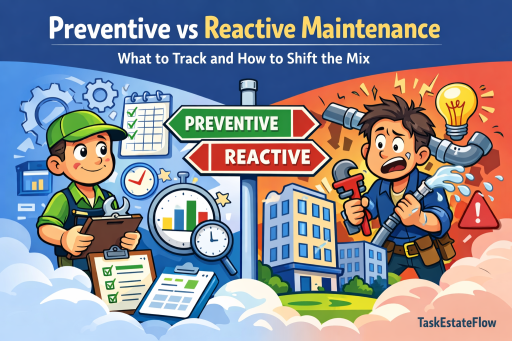
- Reactive maintenance is work initiated by a failure event (leak, outage, malfunction, complaint) and typically arrives as an urgent request.
- Preventive maintenance is work initiated by a plan (schedule, inspection finding, asset lifecycle trigger, performance trend) to reduce the likelihood or impact of failure.
Many teams unintentionally misclassify work. For example, repeated “same issue” tickets are often treated as independent reactive events rather than a pattern that should trigger preventive intervention. Accurate classification is foundational to improving the mix.
What to Track: The Minimum Maintenance Metrics That Change Behavior
Shifting from reactive to preventive maintenance does not require complex analytics to start. It requires the right handful of metrics, consistently captured and reviewed. The most useful measures are those that reveal where time is lost and where repeat work is generated.
1) Reactive volume vs preventive volume
Track the share of work orders that are reactive versus planned. This is the headline indicator for whether the organization is moving in the right direction.
2) Repeat work rate (same issue, same location, short timeframe)
Repeat work is a core signal that reactive activity is masking an underlying cause. Identifying repeat patterns by unit, building, or asset is often the fastest route to meaningful preventive wins.
3) Mean time to assign and mean time to complete
These two measures expose throughput constraints. If assignment is slow, your process is the bottleneck. If completion is slow, capacity, parts, access, or prioritization may be the limiting factor.
4) Backlog aging
Backlog aging (how long work stays open) is an operational risk indicator. As aging grows, preventive maintenance gets crowded out, and service levels decline.
5) Workload distribution
Preventive maintenance requires deliberate scheduling. If workload is consistently unbalanced across staff or properties, preventive work will not reliably happen.
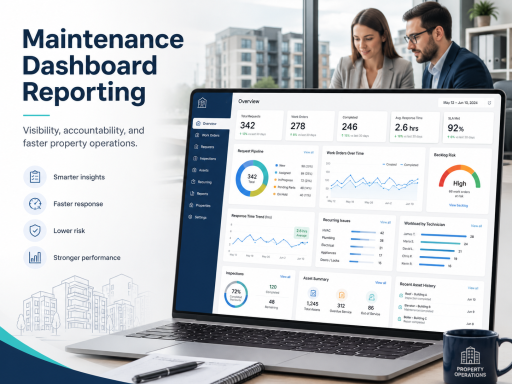
These metrics are easiest to operationalize when your organization uses centralized maintenance dashboards and reporting that surface pipeline health and recurring trends without manual spreadsheet reconciliation.
Work Orders ↔ Reporting ↔ Inspections: Build the Preventive Feedback Loop
Preventive maintenance becomes sustainable when it is supported by a closed-loop workflow. The simplest loop is:
- Work is executed and documented as a work order
- Performance trends and recurring issues are measured in reporting
- Inspections validate quality and generate preventive actions where needed
This loop depends on disciplined work order capture. When work details are incomplete or inconsistent, reporting cannot reliably identify patterns. A standardized workflow using work order management software for property maintenance makes preventive planning possible by producing consistent data from day-to-day execution.
Inspections are often the most underutilized preventive lever. An inspection program that documents findings and triggers follow-up work is a direct mechanism for converting reactive “surprises” into planned work. When inspections are treated as operational inputs rather than isolated checklists, they reduce rework and improve reliability across the portfolio.
To formalize inspections as part of your preventive strategy, connect inspection findings to work actions using property inspection software for buildings and units.
Properties/Units ↔ Assets ↔ Reporting: Use Context to Stop Repeating the Same Work
The most common barrier to preventive maintenance is not a lack of intent—it is a lack of context. If you cannot reliably tie issues to the correct location and the correct asset, you cannot see patterns early enough to intervene.
Location context: analyze by unit, building, and property
Preventive planning requires location-based history. If repeated failures are occurring in one building, the solution may involve shared systems, local conditions, or installation quality. A structured portfolio model supports this analysis and avoids misleading averages that hide property-specific issues.
Ensure your portfolio is structured so maintenance history is reliably attributable using a property, building and unit management platform.
Asset context: move from “fix the symptom” to “manage the lifecycle”
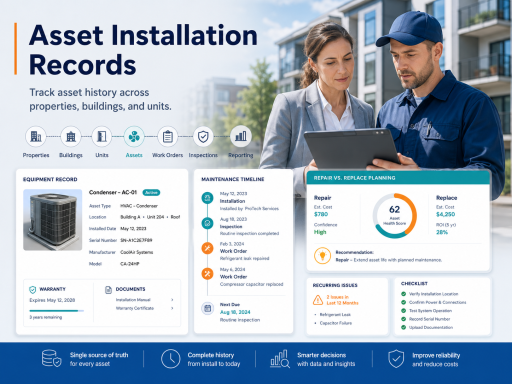
Many repeat work orders are not “bad technicians” problems—they are lifecycle problems. Without installation history and asset context, teams repeatedly diagnose the same equipment and treat each incident as unique. Asset records allow you to correlate failures with age, installation dates, and patterns of repeated repairs.
Start by capturing foundational asset history with asset installation records for property maintenance. When combined with reporting, these records support evidence-based repair-versus-replace decisions and help shift recurring reactive work into planned preventive interventions.
Operational Steps to Shift Capacity Toward Preventive Maintenance
Shifting the maintenance mix is a capacity and discipline challenge. The fastest improvements come from operational changes that protect time for preventive work while keeping reactive response reliable.
Step 1: Standardize intake so reactive work is triaged correctly
If requests arrive informally, triage is inconsistent and urgent work crowds out everything else. Standardized intake improves prioritization and reduces time wasted clarifying requests.
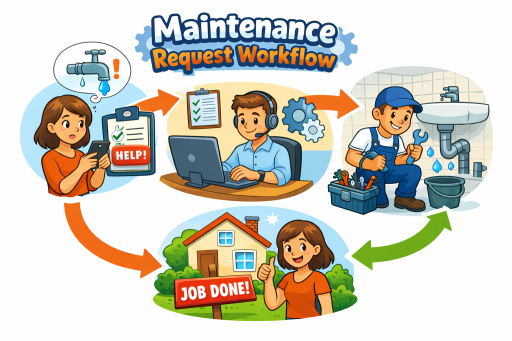
A structured request flow through a resident maintenance requests portal provides cleaner categorization and faster routing—so teams can respond quickly while preserving bandwidth for planned work.
Step 2: Protect a fixed preventive time block each week
Preventive work must be scheduled, not “fit in.” Many teams start with a simple rule: reserve a fixed portion of technician capacity each week for preventive tasks, then adjust based on backlog and seasonality. The objective is consistency.
Step 3: Convert recurring issues into preventive work orders
Use your repeat work rate to identify the top recurring issues and convert them into planned interventions. Common examples include recurring HVAC issues, repeated drain clogs in the same stack, or repeat leaks near aging fixtures. The value is not only fewer tickets; it is fewer disruptions.
Step 4: Use inspections to generate preventive actions
Inspections can be used strategically: high-risk assets, high-complaint buildings, or seasonal checks. The purpose is to generate work before failure, not after failure.
Step 5: Track results monthly and adjust the mix deliberately
Publish the core metrics internally: reactive vs preventive share, repeat work rate, backlog aging, and time-to-assign/complete. When the team sees progress, preventive maintenance becomes an operational habit rather than a “nice to have.”
Governance That Keeps Preventive Work Consistent
Preventive maintenance requires governance: who can approve planned work, who can schedule it, who can close it, and who can verify outcomes. Without role clarity, preventive tasks get deferred during busy periods and never re-enter the schedule.
Role-based access controls help teams maintain consistency by aligning authority to responsibility, particularly in multi-property operations where oversight must scale. For example, managers may approve planned interventions while staff execute and inspectors verify outcomes.
Define and enforce these responsibilities through user and role management for property maintenance teams.
Where to Start: Centralize the Workflow, Then Optimize the Mix
The most reliable path to shifting the maintenance mix is to first centralize the workflow that produces consistent operational data. When intake, work orders, inspections, asset history, and reporting are connected, preventive maintenance becomes easier to plan and easier to defend operationally.
If you are consolidating tools, begin with property maintenance software that unifies the end-to-end workflow—then use metrics and asset context to shift capacity from reactive response to planned interventions.
Pricing and Next Step
If you are ready to replace fragmented coordination with a centralized platform—and begin shifting your maintenance mix using measurable operational signals—review options on the pricing page.
FAQ
What is a good preventive vs reactive maintenance ratio for property operations?
There is no single universal target. The most practical approach is to establish a baseline (current mix), then improve it gradually while tracking response time and backlog aging. The “right” ratio is one that reduces repeat failures without compromising urgent response.
Which metric is the best early indicator that preventive maintenance is working?
The repeat work rate is often the fastest indicator. When preventive interventions address root causes, repeat tickets in the same locations and issue types decline—often before overall ticket volume drops.
How do asset records help shift maintenance from reactive to preventive?
Asset installation history provides lifecycle context. When you can see asset age and repair history, you can identify recurring failure patterns and schedule preventive interventions or replacements before repeated incidents occur.