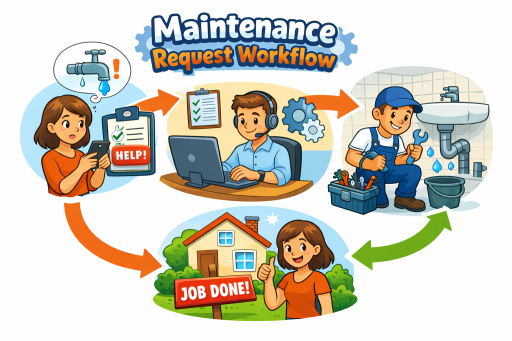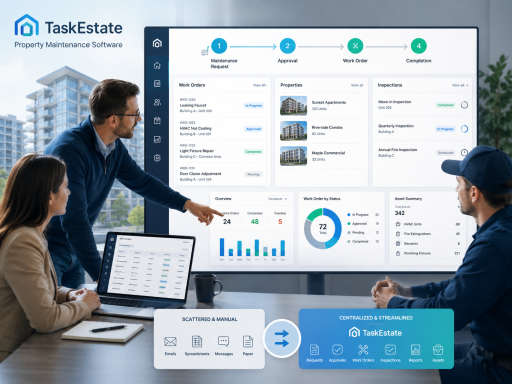
Property maintenance should be operationally simple: a resident reports an issue, a manager approves the work, a technician completes the job, and leadership can see performance across the portfolio. In reality, many teams run maintenance through scattered emails, spreadsheets, and phone calls—tools that were never designed to manage approvals, accountability, or a portfolio-wide audit trail.
The result is familiar: slow response times, inconsistent status updates, unclear ownership, and limited visibility into recurring issues by building or unit. A modern maintenance program needs a single system of record that connects intake, execution, verification, and performance measurement. That is exactly what property maintenance software should do: centralize workflows so property managers can run maintenance with predictable service levels and measurable outcomes.
Why Maintenance Breaks Down in Email and Spreadsheets
Emails and spreadsheets are useful for communication and lists, but they break down when used as an operations system. They create structural weaknesses that compound over time:
- Lost requests and unclear ownership when messages are forwarded, buried, or handled verbally.
- Delayed approvals because authorization is informal and hard to track.
- Inconsistent execution when technicians receive incomplete scope, missing location details, or changing priorities.
- No reliable audit trail when status updates live across threads and ad hoc notes.
- Manual reporting that arrives too late to prevent backlog growth or repeat incidents.
A centralized platform replaces these failure modes with structured workflows, consistent statuses, and portfolio visibility. Most importantly, it reduces the day-to-day coordination tax that keeps property managers reactive.
Centralize the Full Lifecycle: Request → Approval → Work Order → Completion
High-performing operations follow a standardized lifecycle. When every request moves through the same steps, teams reduce handoffs and increase accountability. TaskEstate supports an end-to-end workflow designed for property managers and maintenance teams.
1) Standardize resident intake to reduce back-and-forth
Maintenance operations accelerate when requests arrive with consistent information. Instead of chasing details through messages, a structured intake flow captures the essentials up front and routes the request into the maintenance pipeline. This is especially important in portfolios where many issues look similar but require different urgency and access considerations.
TaskEstate supports structured intake through a resident maintenance requests portal, helping teams reduce clarification cycles and improve time-to-first-touch.
2) Make approvals a workflow checkpoint, not a guessing game
Approvals should protect priorities and budgets without slowing routine work. A formal review step provides consistent governance: what gets approved, by whom, and when. This prevents unauthorized work while ensuring urgent issues move immediately.
When approvals are consistent, property managers can focus on decisions instead of reconstruction—no more searching inboxes for “did we approve this?” and no more work performed without clear authorization.
3) Execute consistently with structured work orders
Work orders are the operational backbone of property maintenance. They translate requests into actionable assignments with ownership, scope, location, and status. Standardization here is what creates predictability across buildings and teams.
TaskEstate supports execution discipline through work order management software that helps property teams assign work, track progress, and close tasks with a complete job history.
Work Orders ↔ Reporting ↔ Inspections: Build a Closed-Loop Maintenance System
Maintenance performance improves fastest when the organization closes the loop: execution is measured, outcomes are verified, and recurring issues are prevented. That requires tight linkage between work orders, reporting, and inspections.
Measure what matters with operational reporting
Without reporting, maintenance becomes “what’s loudest wins.” With reporting, property managers can manage service levels and proactively address bottlenecks. The goal is not more data—it is clearer decisions, such as where backlog is forming, which issue types are repeating, and whether staffing is aligned to demand.
TaskEstate provides portfolio visibility through maintenance dashboards and reporting that track response time, completion trends, workload distribution, and recurring issues across the portfolio.
Verify outcomes and reduce repeats with inspections
Inspections are the control function that prevents repeat work. When inspections are disconnected, teams rely on complaints to identify incomplete repairs. When inspections are integrated, quality verification becomes a standard operating procedure: document outcomes, confirm completion, and create follow-up work immediately when needed.
TaskEstate supports this verification layer through property inspection software that ties findings back to the maintenance workflow for faster resolution and stronger compliance documentation.
Properties/Units ↔ Assets ↔ Reporting: Add Context That Improves Decisions
Speed is important, but context is what improves decisions. Maintenance teams waste time when they cannot quickly understand where an issue is occurring, what work has already been done there, and whether an underlying asset is approaching end-of-life. TaskEstate strengthens decision quality by connecting maintenance activity to location and asset history.
Location structure that keeps records accurate
Maintenance records are only useful when they are tied to the right place. A clean portfolio structure ensures every request, work order, and inspection is connected to the correct unit, building, and property—so reporting is trustworthy and repeat issues can be identified quickly.
TaskEstate supports portfolio organization through a property, building, and unit management platform that keeps operational records consistently location-aware.
Asset history that supports lifecycle maintenance
Recurring issues often point to asset lifecycle problems: aging HVAC components, failing appliances, or infrastructure nearing replacement. When asset details live in disconnected documents—or only in staff memory—teams repeat diagnostic work and miss replacement timing.
TaskEstate supports lifecycle context with asset installation records that preserve what was installed, where it resides, and when it was installed—so reporting can distinguish between one-off incidents and chronic failures.
Role Clarity and Governance Across the Maintenance Team
Even the best workflow will slow down if permissions are unclear. Property maintenance spans multiple roles, and each needs different capabilities: managers approve and oversee, technicians execute and update, inspectors verify outcomes, and administrators maintain portfolio controls.
TaskEstate supports operational governance through user and role management, helping teams align permissions to responsibilities and preserve accountability as portfolios and staffing scale.
What Property Managers Gain From Centralization
When maintenance workflows are centralized, the benefits are immediate and measurable:
- Faster response time through structured intake, streamlined approvals, and clear assignments.
- Stronger accountability via consistent statuses, ownership, and a complete audit trail.
- Less repeat work through inspection verification and asset context that supports better decisions.
- Portfolio visibility with reporting that highlights bottlenecks, recurring issues, and workload imbalances.
- Scalable operations as new properties and team members follow the same standardized process.
Most importantly, centralization replaces operational noise with operational control—so property managers spend less time coordinating and more time improving outcomes.
Evaluate the Workflow Across Your Portfolio
If you are ready to replace emails, spreadsheets, and phone calls with one centralized platform that improves accountability and response time, review plans and rollout options on the pricing page.
FAQ
What is property maintenance software?
Property maintenance software centralizes maintenance workflows—request intake, approvals, work orders, status tracking, inspections, and reporting—so property managers can reduce delays and manage performance across properties.
How does centralization improve response time?
Centralization reduces handoffs and “lost work” by standardizing intake and approvals, assigning clear ownership, and providing real-time status visibility. Teams spend less time coordinating and more time executing.
Can I report performance by unit, building, and property?
Yes. When maintenance activity is tied to a portfolio structure, reporting can identify trends and recurring issues at the unit, building, property, or portfolio level—supporting staffing and planning decisions.
How do inspections reduce repeat work orders?
Inspections verify that work was completed correctly, document outcomes, and trigger follow-up actions when needed. This closes the loop between execution and quality verification, preventing repeat issues from resurfacing.