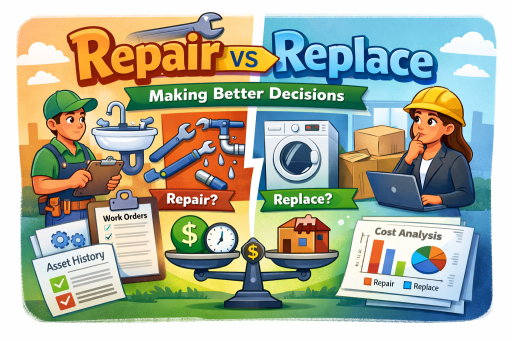
Repair-versus-replace decisions sit at the intersection of resident satisfaction, operating cost, and asset reliability. When these decisions are made reactively—based on the last complaint, the loudest escalation, or incomplete information—properties absorb avoidable repeat labor, extended downtime, and inconsistent outcomes across buildings and units.
A better approach is to treat repair-versus-replace as an operations workflow supported by consistent data: clean intake, standardized work orders, inspections that verify outcomes, asset history that provides lifecycle context, and reporting that highlights trends. TaskEstate is designed to unify those inputs inside a single operations platform, turning maintenance activity into decision-grade information through property maintenance software.
Why Repair vs Replace Is Hard in Property Operations
Property managers typically face three constraints when deciding whether to repair or replace:
- Incomplete history: prior repairs are buried in emails, vendor invoices, or spreadsheets, making repeat failures hard to prove.
- Unclear asset context: installation date, warranty, model, and unit location are not consistently tracked.
- No portfolio visibility: managers can’t easily see whether an issue is isolated or systematic across a building or property.
The result is predictable: assets get repaired too long (leading to repeat work orders) or replaced too early (wasting capital). The goal is not perfection—it is consistent, defensible decisions that reduce repeat incidents and improve response time.
The Decision Framework: Repair vs Replace in Five Questions
Use the following five-question framework to standardize decisions across your portfolio. The strength of this approach is that it can be applied consistently by different managers and teams, reducing variability and improving accountability.
1) Is this a repeat failure or a one-off incident?
Repeat incidents are the most reliable indicator that replacement should be considered. The key is having a standardized record of prior interventions and outcomes. Without that, teams debate from memory and incomplete anecdotes.
When work history is captured consistently via work order management, you can quickly determine whether the same asset or location has generated multiple tickets over a defined period and whether the fixes were substantive or temporary.
2) What is the asset’s lifecycle context (age, warranty, installation)?
Asset age and installation context materially change the economics of repair. A new asset with a manufacturing defect might be best handled through warranty or targeted repair. An older asset at or beyond its typical lifecycle may be a replacement candidate even after a single failure—especially if the failure disrupts resident experience.
Lifecycle decisions become more consistent when the organization maintains structured history through asset installation records that preserve what was installed, where it lives, and when it was installed.
3) What is the total cost of ownership for “keep repairing”?
Repair cost is not just parts and labor. It also includes repeat visits, scheduling overhead, resident dissatisfaction, and the operational disruption of recurring failures. A repair that looks “cheap” on paper can be expensive when it repeats.
A practical rule is to evaluate total cost over a rolling window (for example, the last 6–12 months) and compare it to replacement cost. If repeat tickets are increasing or downtime is affecting resident satisfaction, replacement often becomes the financially disciplined option.
4) Can an inspection validate the root cause and confirm resolution?
Many repeat work orders are not caused by “bad assets” but by incomplete diagnosis, inconsistent workmanship, or unresolved contributing factors (e.g., leaks causing recurring damage, improper installation, or tenant misuse). Inspections help distinguish asset failure from process failure.
Use property inspections to document the underlying condition, verify work quality, and trigger follow-up actions when needed. This reduces repeat repairs that happen because the original issue was never fully resolved.
5) Is the issue isolated to one unit, or trending across the portfolio?
Portfolio-scale patterns change the decision. If similar assets are failing across a building, the right answer may be a planned replacement program, not repeated repairs. This is where location context and reporting matter.
Decisions improve when work and asset history are consistently tied to the right location using property, building, and unit management. That structure makes it possible to identify whether issues cluster by unit type, building, or installation batch.
How Adjacency Improves Decisions: Work Orders ↔ Reporting ↔ Inspections
Repair-versus-replace decisions become significantly more accurate when you operate a closed loop:
- Work orders capture what was done, what it cost, and the outcome.
- Inspections validate resolution quality and document asset condition.
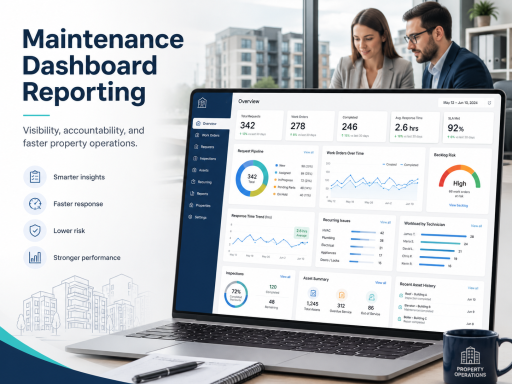
- Reporting surfaces recurrence, bottlenecks, and portfolio patterns.
TaskEstate operationalizes this loop by turning maintenance activity into measurable signals through maintenance dashboards and reporting. This helps property managers stop debating from memory and start deciding from evidence.
How Adjacency Improves Decisions: Properties/Units ↔ Assets ↔ Reporting
Lifecycle decisions are not purely asset decisions; they are also location decisions. A failing asset in a high-impact unit type may justify replacement sooner due to resident impact. A building-wide pattern may justify a planned capital strategy. These judgments require:
- Location structure to isolate where failures occur.
- Asset records to understand what is failing and why.
- Reporting to quantify recurrence and cost.
When these three are connected, you can identify whether you are dealing with an asset issue, an installation issue, or an environmental issue—and choose the right intervention.
The Playbook: Standardize Repair vs Replace Decisions in Operations
To make decisions repeatable across managers and properties, implement a lightweight playbook. The objective is consistent triage and documentation, not bureaucracy.
Step 1: Standardize intake so the request is actionable
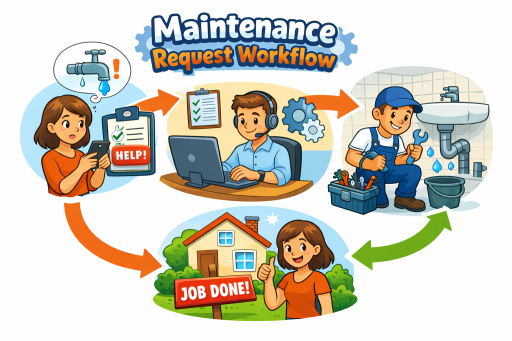
Decision quality starts at intake. If issue descriptions are vague or inconsistent, diagnosis becomes slower and repeat tickets increase. Structured intake reduces ambiguity and improves first-visit success.
Enable consistent information capture through a resident maintenance requests portal so requests include the detail required for triage and assignment.
Step 2: Require complete work order closeout notes
To compare repair outcomes over time, you need consistent closeout data. Establish a minimum standard for completion notes:
- Observed issue and confirmed root cause (if known)
- Work performed and parts used
- Outcome and any follow-up required
- Recommendation: monitor, repair again if X, or replace if Y
Step 3: Trigger inspection verification for repeat issues
If an issue repeats within a defined window, route it for verification. Inspections reduce “false repairs” where work was completed but not effectively resolved.
Step 4: Establish replacement thresholds
Replacement thresholds prevent indecision and reduce reactive spending. Examples include:
- More than N work orders tied to the same asset in X months
- Total repair cost exceeds a defined percentage of replacement cost within X months
- Asset age exceeds lifecycle benchmark and failure disrupts resident habitability
- Portfolio trend indicates batch failure (building-wide or model-wide)
Step 5: Use role-based controls so the right people approve replacements
Replacement decisions often require additional authorization. Role-based access clarifies who can approve, who can assign, and who can finalize closure—reducing delays and preventing unauthorized replacements.
Implement governance through user and role management so approvals and accountability remain consistent as portfolios scale.
What to Measure: KPIs That Reveal the True Cost of Repairs
If you want repair-versus-replace to become disciplined, measure what drives the economics. The following KPIs are typically the most useful for property maintenance operations:
- Repeat work order rate for the same asset or location
- Average time to resolution (including reopened work)
- Cost per incident over a defined window
- Reopen rate after completion
- Inspection fail rate on completed work (where inspections apply)
These indicators help managers spot problems early and justify replacement decisions with operational evidence.
Common Scenarios and How the Framework Applies
Scenario A: The “cheap repair” that keeps coming back
If the same unit generates multiple work orders for the same system (e.g., repeated clogs, recurring HVAC issues, intermittent electrical), the decision should be based on the repeat pattern and total cost over time—not the last invoice. Apply the threshold approach and validate root cause through inspection where appropriate.
Scenario B: A building-wide pattern in similar units
When failures cluster by building, unit type, or installation batch, replacement planning is often more cost-effective than repeated repairs. Reporting should highlight the trend, and asset records should confirm whether failures align by age/model/install date.
Scenario C: New asset, early failure
Early failure often suggests warranty, installation quality, or environmental factors. Inspection verification is critical here. Replacement may be warranted, but first confirm whether root cause is the asset itself or the installation/conditions around it.
Cost Discipline Without Slowing Response Time
Property managers should not have to choose between cost discipline and fast service. When workflows are standardized, the organization can move faster precisely because decisions are clearer and data is available in one place. Repairs get executed quickly when they make sense, and replacements are escalated efficiently when thresholds are met.
Next Step: Evaluate Fit and Implementation
If you are ready to replace emails and spreadsheets with a centralized platform that improves accountability and response time, review packaging and rollout options on the pricing page.
FAQ
How many repeat work orders should trigger replacement consideration?
There is no universal number, but a practical standard is to define a rolling window (such as 6–12 months) and trigger replacement consideration when repeat incidents exceed your threshold or when total repair cost approaches a meaningful share of replacement cost. The key is consistency across properties.