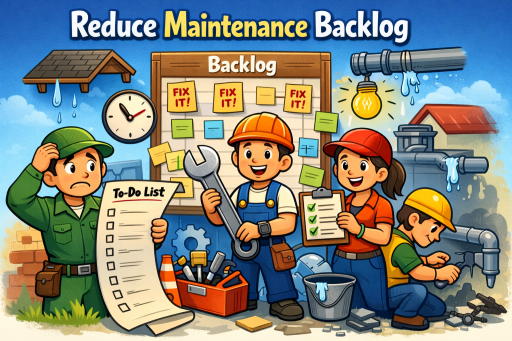
Maintenance backlogs rarely come from a lack of effort. They come from operational friction: requests arrive with missing details, approvals stall, assignments are unclear, statuses aren’t standardized, and managers lack visibility into bottlenecks. The fastest way to reduce backlog without adding headcount is to improve throughput—moving work through a consistent lifecycle with fewer handoffs, fewer rework loops, and better prioritization.
This playbook outlines practical, proven changes property managers can implement to reduce backlog while improving accountability and response time. The goal is not to “work harder,” but to run maintenance as an operational system: structured intake, controlled approvals, disciplined execution, quality verification, and performance measurement.
1) Diagnose the True Bottleneck (Before You “Fix” the Backlog)
Backlog reduction starts with a simple question: where does work stall? In most portfolios, the bottleneck is not technician capacity—it’s the workflow upstream of execution. Typical choke points include:
- Unstructured request intake that produces incomplete tickets and repeated follow-ups
- Approval delays caused by unclear ownership or informal decision-making
- Assignment gaps where tasks sit unowned or bounce between team members
- Rework driven by unclear scope or lack of verification
- Limited visibility into aging work orders and recurring issues
If you cannot reliably see the stage where work stalls, you will default to firefighting. A centralized workflow removes uncertainty and makes bottlenecks visible, which is the first step toward predictable throughput.
2) Standardize Request Intake to Eliminate “Clarification Loops”
Backlog grows when each request requires manual interpretation. The fastest intake systems capture the information needed for decision-making at the point of submission: issue type, location, priority signals, and access details. This reduces the cycle time between “request received” and “ready to assign.”
Use a structured intake channel that converts resident issues into actionable maintenance items with consistent data. For an intake workflow designed for property maintenance teams, see the resident maintenance requests portal.
3) Make Approvals Fast and Predictable (Not Informal and Slow)
Approvals are necessary for budget control and prioritization, but they are also a common source of delay. The fix is not “more approvals.” It is predictable approvals—a defined checkpoint with clear ownership and a fast path for routine work.
- Define which work types require approval vs. auto-approve thresholds (by category, estimated cost, or risk level).
- Set a time expectation for approval decisions (for example, same business day for non-emergencies).
- Require a standard outcome: approve, reject, request info, or convert to vendor workflow.
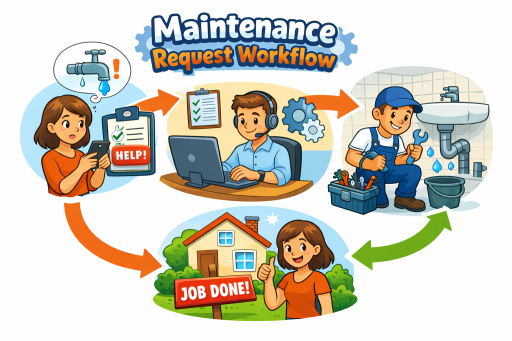
A standardized lifecycle for request → review → approval → assignment → completion reduces the “waiting room” effect that inflates backlog. This is a core capability of work order management software for property maintenance.
4) Improve Throughput with Assignment Discipline and Clear Ownership
Backlog drops when every open item has an owner and a next step. Assignment discipline is not micromanagement; it is operational clarity. Implement these standards:
- One owner per work order (even if multiple staff contribute).
- Defined priorities with explicit service expectations (emergency vs. routine).
- Daily queue review to reassign stalled items and balance workload.
- Blocker tracking (parts needed, access required, vendor scheduling) so “stuck” work is visible.
The most common backlog pattern is “unowned work.” Eliminating that single failure mode produces an immediate improvement in throughput.
5) Use Standard Statuses to Reduce Interruptions and Rework
When statuses are inconsistent, property managers spend their time asking for updates instead of managing operations. Standard statuses make work self-explanatory. A practical status model should:
- Reflect the real workflow stages (new, pending approval, assigned, in progress, waiting, completed, verified).
- Require brief notes when transitioning into “waiting” states (what is needed, by whom, and by when).
- Make aging visible (how long an item has remained in each status).
Standard statuses reduce internal interruption costs and prevent “false completion” that creates repeat work orders.
6) Close the Loop with Inspections to Prevent Repeat Tickets
Repeat issues are hidden backlog. If the same unit generates repeated work orders, your true workload is higher than your open queue suggests. A lightweight inspection step—used selectively for high-impact categories—helps verify outcomes and identify follow-up actions before residents re-report the issue.
This creates the quality loop that reduces rework: work completed → inspection outcome recorded → follow-up triggered if needed. For workflows that connect verification to operational history, see property inspection software for buildings and units.
7) Work Orders ↔ Reporting ↔ Inspections: Manage Backlog Like a Pipeline
To reduce backlog sustainably, treat maintenance as a pipeline with measurable throughput. That requires visibility into:
- Work order aging by status (where items stall)
- Approval time and assignment time (upstream delays)
- Completion time and repeat-work rate (execution quality)
- Workload distribution (capacity balance across staff or properties)
When reporting is connected to work orders and inspections, you can identify bottlenecks and intervene early, instead of reacting after backlog becomes visible to residents. For performance visibility, charts, and operational metrics, use maintenance dashboards and reporting for property operations.
8) Properties/Units ↔ Assets ↔ Reporting: Reduce Backlog by Fixing Root Causes
The fastest way to reduce backlog is to stop creating unnecessary work. Two root-cause levers are location-based history and asset lifecycle context. When work is tied cleanly to where it happened and what equipment was involved, you can spot recurring failures and address the source.
Start by ensuring work is consistently tied to the correct location structure using property, building, and unit management. Then layer in asset-level history with asset installation records so teams can identify chronic failures, aging equipment, and replacement candidates that drive repeat tickets.
This is how maintenance shifts from “endless tickets” to lifecycle operations—reducing backlog pressure over time.
9) Reduce Operational Drag with Role Clarity and Permission Boundaries
Backlog increases when approvals, assignments, and closures are delayed by unclear authority. Define roles so the right people can take the right actions quickly, while maintaining governance across the portfolio. This reduces handoffs, prevents unauthorized work, and speeds decision-making.
For structured permissions aligned to property teams, see user and role management for property maintenance teams.
10) A 14-Day Backlog Reduction Sprint (Practical Implementation Plan)
If you want quick results, run a two-week operational sprint. The goal is to increase throughput immediately and stabilize the workflow.
Days 1–3: Intake and triage
- Standardize request categories and required fields.
- Define emergency vs. routine rules and priority levels.
- Stop accepting “floating” requests that lack location details.
Days 4–7: Approvals and assignment discipline
- Define which work types require approval and set a same-day approval expectation.
- Assign an owner to every open item and set a “next step” rule for anything waiting.
- Run a daily 15-minute queue review focused on aging work.
Days 8–14: Status standards, inspection loop, and reporting
- Implement standardized statuses and require notes for “waiting” states.
- Add selective inspections for high-impact categories to reduce repeat tickets.
- Review pipeline metrics weekly and address the stage with the highest aging.
Choose a Platform That Replaces Disconnected Tools
Backlog reduction becomes sustainable when your maintenance workflow lives in one system—intake, approvals, work orders, inspections, asset context, and reporting—rather than across disconnected tools. If you are currently coordinating through email threads and spreadsheets, a unified platform will reduce operational drag and improve response time.
To see the broader platform that connects these modules into one workflow, explore property maintenance software. When you’re ready to evaluate options and plan rollout, review TaskEstate pricing.
FAQ
What is the fastest way to reduce a maintenance backlog?
Standardize intake, approvals, assignment ownership, and status tracking first. Backlog typically shrinks when items stop stalling upstream of execution and every open work order has an owner and a next step.
How do I reduce repeat work orders that keep refilling the backlog?
Add a selective verification loop for high-impact categories and tie work history to locations and assets. Inspections and asset history help identify recurring root causes so you can fix the source rather than repeatedly treating symptoms.
Which metrics should property managers track to prevent backlog from returning?
Track approval time, assignment time, work order aging by status, completion time, and repeat-work rate. These pipeline measures highlight where work stalls and which issue types are driving rework.