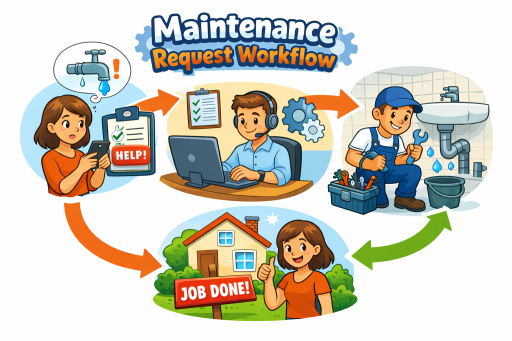
Repeat maintenance requests are a hidden tax on property operations. They inflate backlog, erode resident trust, and force maintenance teams to spend time re-diagnosing issues that should have been solved the first time. In many portfolios, the root cause is not skill or effort—it is an inconsistent closeout process. Work gets marked “done” without verified outcomes, clear documentation, resident confirmation, or asset context.
A professional closeout standard turns maintenance into a closed-loop operation: the issue is resolved, validated, documented, and measured. This article provides a practical, portfolio-friendly closeout playbook that reduces repeat tickets while improving accountability and response time—without adding unnecessary administrative overhead.
For teams centralizing operations end-to-end, the most effective foundation is a unified platform such as property maintenance software that replaces email threads and spreadsheets with a consistent workflow and system of record.
Why Repeat Requests Happen (and Why Closeout Fixes Them)
Repeat requests typically come from one of five operational failure points:
- Unverified outcomes: the work was performed, but the issue was not fully resolved or tested.
- Weak documentation: the next technician has no context, so troubleshooting starts from zero.
- Resident uncertainty: residents do not know the status or do not feel the problem was addressed.
- Missing location context: the problem is not reliably tied to a specific unit/building, so patterns remain invisible.
- No asset history: recurring failures look like isolated incidents, delaying repair-versus-replace decisions.
A standardized closeout process addresses each point by requiring: verification, documentation, clear communication, and structured data that feeds reporting. Done correctly, closeout is not “extra work”—it is the step that prevents additional work.
The Closeout Standard: A Five-Part Checklist That Cuts Repeat Tickets
1) Confirm the resolution with a simple “proof of fix” step
The most common closeout mistake is treating “work performed” as “issue resolved.” Closeout should include a light-weight verification appropriate to the job type:
- Functional test: confirm the equipment performs as expected (e.g., run cycle, check temperature, verify flow).
- Safety check: validate conditions are safe (e.g., leak re-check, electrical test where relevant).
- Repeat-symptom test: confirm the original symptom no longer occurs under normal use.
This verification step pairs naturally with quality control through property inspection software when your operation requires formal validation for certain work types or compliance-sensitive areas.
2) Document what matters (not everything)
Documentation should be standardized and concise. The goal is operational continuity: any technician or manager should understand what happened in under 30 seconds.
Require these fields at closeout:
- Root cause summary: one sentence explaining the cause, not just the symptom.
- Action taken: repair performed, part replaced, adjustment made, or vendor action completed.
- Verification method: how the fix was validated (test run, inspection, re-check).
- Follow-up needed: yes/no, with date window if applicable.
Standardized closeout documentation is easiest to enforce when the workflow runs through a structured system like work order management, where closeout fields and status rules can be implemented consistently across teams and properties.
3) Close the communication loop with residents
Many “repeat” tickets are not repeat failures—they are repeat reports caused by uncertainty. If residents are not confident the issue was handled, they submit another request. A closeout standard should include a resident-facing summary that is clear and non-technical:
- What was done: short description in plain language.
- What to expect: any normal behavior after the repair (e.g., noise, settling, drying time).
- What to do if it returns: a single instruction that routes them back into the same system.
This loop is strongest when requests originate from a consistent intake channel such as a resident maintenance requests portal, which reduces duplication and keeps communication tied to the same record.
4) Tie the work to location structure so patterns appear
Repeat maintenance becomes manageable when it becomes visible. That visibility depends on location structure. If work is not reliably tied to the correct unit/building/property, reporting becomes unreliable and recurring issues are missed.
A portfolio structure model supports disciplined closeout by ensuring every job is anchored to the right place. This capability is enabled by property, building, and unit management, which makes it possible to identify repeat problems by unit, building, and property—rather than relying on memory or manual spreadsheets.
5) Link closeout to asset history to prevent “diagnose-and-repeat” cycles
Some repeat tickets are not “bad repairs”—they are end-of-life assets. Without asset history, teams keep repairing the same equipment without seeing the full pattern. Closeout should capture whether the issue is associated with an asset that has repeated failures or is approaching replacement time.
Lifecycle context is supported by asset installation records, which preserve what was installed, where it is located, and when it was installed. When closeout data is connected to asset history, decisions shift from reactive repairs to proactive replacements that reduce repeat failures.
Turn Closeout Into a Feedback System With Reporting
A closeout process becomes truly valuable when it produces operational signals—so you can reduce repeats systematically, not incident-by-incident. The key is converting closeout data into metrics that reveal patterns.
Use maintenance dashboards and reporting to track repeat-driven indicators such as:
- Repeat request rate: percentage of requests reopened or re-submitted within a defined window (e.g., 14–30 days).
- Reopen reasons: categories that frequently recur (plumbing, HVAC, appliances, access issues).
- Time-to-close vs. repeat: identify whether rushed closeouts correlate with repeats.
- Repeat by location: units/buildings with abnormal repeat rates (often signaling asset end-of-life or environmental issues).
This is where your adjacency rules matter operationally: Work Orders ↔ Reporting ↔ Inspections creates a loop where execution produces data, reporting identifies risk, and inspections confirm quality when needed. Similarly, Properties/Units ↔ Assets ↔ Reporting ensures patterns are tied to location and lifecycle context so you can prevent repeat incidents instead of just responding faster.
Operational Controls That Make Closeout Stick
Closeout standards fail when they are optional. The goal is not bureaucracy—it is consistency. These controls improve adoption without slowing teams:
- Closeout criteria by job type: require verification fields only for higher-risk categories (e.g., leaks, HVAC, safety issues).
- Required closeout fields: enforce a minimal set of documentation fields that take under one minute to complete.
- Clear ownership rules: the person who closes the work order must confirm verification and documentation.
- Periodic inspection sampling: inspect a small percentage of completed work to reinforce quality norms.
Role clarity is critical for enforcement. Permissions should align to responsibilities (who can approve, who can close, who can inspect). This governance is supported through user and role management, keeping accountability clean and preventing “closeout by proxy.”
A Practical 30-Day Rollout Plan
Week 1: Define the closeout checklist
- Choose the minimum required closeout fields (root cause, action taken, verification method, follow-up).
- Define “high-risk categories” that require additional verification or inspection.
Week 2: Implement status and closeout rules
- Standardize statuses and define what qualifies as “completed.”
- Train staff with examples of good closeout notes vs. inadequate notes.
Week 3: Start measuring repeats
- Track repeat rate and top repeat categories.
- Review repeat incidents weekly and identify the leading cause (verification gap, documentation gap, asset end-of-life).
Week 4: Add targeted inspections and asset actions
- Introduce inspection sampling for categories driving repeats.
- Tag recurring assets for lifecycle review and replacement planning.
When Closeout Improvement Pays Off Fastest
You typically see the highest impact from closeout standardization in these scenarios:
- High-ticket volume properties where repeats are consuming technician time and inflating backlog.
- Multi-property portfolios where inconsistent processes create uneven performance.
- Assets approaching end-of-life where repairs are frequent but replacements are not being planned.
- Resident dissatisfaction driven by “we already reported this” frustration.
In each case, the operational advantage comes from reducing rework. Eliminating avoidable repeats is one of the most reliable ways to improve response time without hiring additional staff.
Next Step
If you are ready to reduce repeat maintenance requests, start by making closeout a measurable standard—not a discretionary habit. Centralizing your workflow and data in one platform makes it easier to enforce closeout rules, connect work to inspections, and turn trends into action.
To understand packaging and onboarding options, review pricing.
FAQ
What is the fastest way to reduce repeat maintenance requests?
Standardize closeout with a minimal checklist: root cause, action taken, verification method, and clear resident-facing completion notes. Then measure repeats by category and location to target the biggest drivers.
Do inspections help reduce repeats?
Yes—especially when applied selectively. Sampling inspections for higher-risk work types reinforces quality and confirms that fixes are resolved, not just performed.
How do I know whether repeats are caused by assets nearing end-of-life?
Link work history to asset context. When recurring failures cluster around the same equipment, replacement planning often resolves repeat tickets more effectively than repeated repairs.