Resident satisfaction is not won by sending more emails or chasing more status updates. It is won when maintenance feels predictable: requests are acknowledged, work is assigned quickly, repairs are completed correctly, and repeat issues are rare. For property managers, the operational challenge is clear—maintenance coordination often lives across disconnected tools, making response time and accountability harder than they need to be.
This article explains the practical maintenance workflows that most directly improve resident experience and shows how to replace ad hoc coordination with a centralized platform that reduces delays, prevents repeats, and provides portfolio visibility.
Why maintenance is the strongest driver of resident experience
Residents judge a property’s day-to-day quality largely through maintenance. A clean lobby matters, but the moments that shape satisfaction are personal and immediate: a leaking sink, a broken HVAC, a door that won’t lock, a recurring appliance failure. What residents remember is not internal complexity—they remember whether the issue was handled quickly and whether it stayed fixed.
In practice, satisfaction rises when your operation consistently delivers on four outcomes:
- Speed: time from request to first action is short and reliable.
- Clarity: residents do not have to “chase” updates or repeat information.
- Quality: repairs are completed correctly and verified when appropriate.
- Prevention: repeat issues decline because root causes are addressed.
Achieving these outcomes requires system design, not heroics. That is where a centralized property maintenance software platform becomes a resident-experience tool as much as an operations tool.
What actually improves response time (and what does not)
Most “slow maintenance” problems are workflow problems. The delays typically come from the same places:
- Requests arrive through multiple channels, with incomplete information.
- Managers spend time clarifying details and determining whether work should be approved.
- Assignments are delayed due to unclear ownership or manual handoffs.
- Status updates are inconsistent, prompting residents to follow up—adding workload and interruptions.
What does not reliably improve response time: sending more messages, maintaining more spreadsheets, or relying on individual memory (“I think we handled that last month”). Those tactics increase effort but do not reduce operational friction.
What does improve response time: standardizing the lifecycle from intake to completion using work order management software for property maintenance so requests are consistently reviewed, approved, assigned, tracked, and closed.
Start with clean intake: faster requests, fewer follow-ups
The most important resident experience improvement often happens before the work begins: structured request intake. If residents submit requests by email, phone calls, texts, or informal conversations, the team spends time re-entering details, asking clarifying questions, and triaging without consistent information.
A dedicated intake flow reduces friction for residents and reduces administrative burden for staff. With a resident maintenance requests portal, requests can be captured in a consistent format—supporting faster routing, better prioritization, and fewer “missing details” delays.
Operationally, clean intake improves:
- Time-to-assign: staff receive actionable work orders sooner.
- First-visit resolution: technicians arrive with clearer context.
- Resident confidence: residents feel heard because the process is consistent and responsive.
Reduce “black holes” with a real work order lifecycle
Residents get frustrated when maintenance becomes a black hole: they submit a request and hear nothing, or they receive vague updates that do not reflect real progress. This often occurs when work is tracked in spreadsheets or scattered communications rather than in a single, trackable workflow.
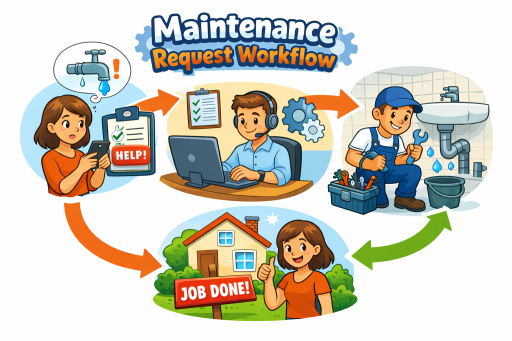
A structured lifecycle—request → review → approval → assignment → completion—creates operational predictability. It makes ownership explicit, and it makes status measurable. For property managers, this means fewer escalations and fewer “can you check on this?” interruptions because the system is already tracking progress.
The practical goal is simple: every request should be in one of a few clearly defined states, and every state should have an owner and a next action. This discipline is easier to implement when work is tied to portfolio structure through property, building, and unit management, ensuring maintenance history is always anchored to the correct location.
Work Orders ↔ Reporting ↔ Inspections: close the loop on quality
Speed matters, but quality is what protects satisfaction over time. A fast repair that fails again is worse than a slower repair done correctly. A high-performing operation closes the loop with verification and learning:
- Work Orders: ensure the job is clearly defined, owned, and tracked.
- Inspections: verify completion and document outcomes where appropriate.
- Reporting: identify patterns, bottlenecks, and recurring issues to drive continuous improvement.
Quality verification can be built into your operating model through property inspection software for buildings and units, which supports documented outcomes and follow-up actions when needed. Performance learning happens through maintenance dashboards and reporting, which turn maintenance activity into operational visibility—response time trends, backlog drivers, repeat issues, and workload distribution.
When these three elements are connected, resident experience improves in a measurable way: fewer repeat tickets, fewer escalations, and more consistent service levels across the portfolio.
Properties/Units ↔ Assets ↔ Reporting: prevent repeats with lifecycle context
Repeat maintenance issues often happen because the organization lacks asset context. If your team does not know what equipment was installed, when it was installed, and what history it has, you end up repeating diagnostics and applying short-term fixes.
This is where asset lifecycle discipline creates resident-experience dividends. With asset installation records for property maintenance, teams can track what was installed, where it lives, and when it was installed—making it easier to spot aging assets, recurring failures, and replacement thresholds. When asset history is paired with reporting, you can identify high-repeat assets and prioritize replacements that reduce resident disruption.
In resident terms, this is the difference between “we keep patching the same issue” and “we fixed it and it stayed fixed.”
Make accountability automatic with role-based operations
Resident satisfaction drops when accountability is unclear: requests bounce between people, approvals are inconsistent, and no one can confidently answer who owns what. A role-based operating model prevents that by aligning permissions and responsibilities to real workflows:
- Property managers: review, approve, prioritize, and oversee service levels.
- Maintenance staff: execute, update status, document work, and close tasks with consistent standards.
- Inspectors: verify outcomes and trigger follow-ups when needed.
- Admins: maintain governance and consistency across the portfolio.
TaskEstate supports this operational clarity through user and role management for property maintenance teams, enabling cleaner approvals, stronger auditability, and fewer workflow bottlenecks—without slowing execution.
The resident experience metrics that matter most
If you want to improve satisfaction, measure the signals that residents feel. The most useful KPIs typically include:
- Time to first action: request submitted → assigned or scheduled.
- Time to completion: request submitted → resolved.
- Repeat issue rate: the same issue returns within a defined time window.
- Aging backlog: number of requests open beyond your target threshold.
- First-visit resolution proxy: fewer follow-ups and fewer reopened items.
These metrics become more actionable when they can be analyzed by unit, building, and property—so you can identify where resident friction is concentrated and which process changes will create the biggest impact.
Implementation guidance: how to operationalize improvements quickly
For most portfolios, the fastest path to improvement is to standardize the workflow before you expand it. A practical rollout sequence is:
- Unify intake: move requests into a single structured flow.
- Standardize the lifecycle: define statuses, approvals, and closure standards.
- Connect reporting: track response time, completion time, backlog, and repeats.
- Add inspections where needed: verify outcomes for high-risk or high-repeat categories.
- Layer in asset context: build installation records for key assets that drive repeat work.
The operational objective is not “more process.” It is fewer manual handoffs, fewer resident follow-ups, and more predictable service levels.
Next step: centralize maintenance to improve resident satisfaction
If your team is still coordinating maintenance through emails, spreadsheets, and phone calls, resident satisfaction will remain vulnerable to missed handoffs and inconsistent follow-through. Centralizing the workflow improves accountability and response time—and creates the operational foundation for portfolio-level performance.
To evaluate fit and choose an adoption path, review TaskEstate pricing and align the platform scope to your portfolio’s operational needs.
FAQ
What is the fastest way to improve resident satisfaction with maintenance?
Standardize intake and work order execution first. A single request pathway, clear approvals, rapid assignment, and consistent status tracking eliminate the most common delays and reduce resident follow-up.
Why do residents escalate even when maintenance is “in progress”?
Escalations typically happen when progress is not visible or predictable. A structured workflow reduces uncertainty by making ownership and status explicit from the first action through completion.
How do inspections improve resident satisfaction?
Inspections validate quality and reduce repeat issues. When outcomes are documented and follow-ups are triggered immediately, residents experience fewer recurring problems and higher confidence in maintenance reliability.
How can we reduce repeat maintenance issues?
Reduce repeats by pairing work history with asset context. Tracking what was installed, where, and when improves repair-versus-replace decisions and helps prioritize replacements that prevent recurring resident disruption.