Property maintenance breaks down fastest when responsibility is unclear. Requests sit unapproved, work orders get reassigned midstream, inspections are performed without traceable outcomes, and reporting becomes a manual scramble. The underlying cause is often not process— it is permissions. When a platform does not reflect how property teams actually operate, people either cannot take the actions they need, or they can take actions they should not.
This guide explains a practical, role-based access model for property maintenance operations: who should be able to submit, approve, assign, update, inspect, and report—across properties, buildings, and units. It is written for property managers who want to replace emails, spreadsheets, and phone calls with a single operational system that improves accountability and response time.
Why role-based access is the difference between “tracked work” and “managed operations”
In property operations, permissions are not an IT detail. They define how quickly work moves and how reliably work can be audited. When access is too open, you get unauthorized closures, overwritten statuses, and inconsistent data. When access is too restrictive, you get bottlenecks, workarounds, and parallel tracking in spreadsheets.
A modern platform should provide role clarity (who can do what) and scope clarity (where they can do it). This is foundational to consistent workflow execution and is a key capability within property maintenance software designed for real portfolio operations.
The core roles in property maintenance and what they should control
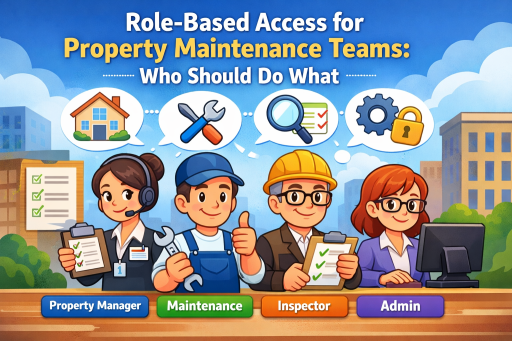
Most maintenance organizations—regardless of portfolio size—map cleanly into four core role groups. The details vary by company, but the principles remain consistent: approvals belong to accountable managers, execution belongs to assigned staff, verification belongs to inspectors, and governance belongs to administrators.
1) Property managers
- Should be able to: review and approve requests, set priorities, assign or reassign work, escalate emergencies, and confirm completion standards.
- Should not be forced to: chase updates in email threads or reconcile multiple “sources of truth.”
- Permission principle: managers own workflow control and accountability outcomes at the property level.
2) Maintenance staff (in-house)
- Should be able to: receive assigned work, update status, add notes, document completion details, and request follow-up approvals when scope changes.
- Should not be able to: approve work beyond defined thresholds, override governance controls, or access properties outside their scope.
- Permission principle: staff should have frictionless execution within clear boundaries.
3) Inspectors
- Should be able to: record inspection outcomes, document findings, and trigger follow-up work where required.
- Should not be able to: quietly “pass” work without traceability or edit execution history in ways that undermine accountability.
- Permission principle: inspection is a verification function, not a rewrite function.
4) Administrators / operations owners
- Should be able to: configure roles, manage scope across the portfolio, define workflow standards, and ensure governance consistency.
- Should not be the “human API”: if daily operations require an admin to unblock normal work, permissions are misconfigured.
- Permission principle: admins enable scale; they should not be required for routine throughput.
TaskEstate supports these operational patterns through user and role management so teams can align platform behavior with real responsibilities.
Scope matters: permissions must map to properties, buildings, and units
Role definitions alone are not enough. A portfolio needs scope: which properties can this person see, and what locations can they act on? Without scope controls, teams either drown in irrelevant data or risk cross-property errors.
The most operationally reliable model is location-aware access tied to a structured portfolio hierarchy. When your platform organizes work consistently by location, reporting improves, audit trails become dependable, and staff spend less time searching for context. This is why role design should be implemented in tandem with property, building, and unit management.
Work Orders ↔ Reporting ↔ Inspections: align permissions to the full loop
A high-performing maintenance operation is a closed loop: execute work, verify outcomes, and measure performance. Role-based access should reinforce that loop rather than break it. The practical approach is to separate “doing” from “verifying” and ensure measurement is visible to the people accountable for outcomes.
Work order execution permissions
The work order lifecycle needs clear action rights: who can approve, assign, update, and close. If multiple roles can close work without standards, your data becomes unreliable. If too few people can assign or update, your response time suffers. Well-designed permissions remove ambiguity while preserving speed—especially when paired with work order management workflows.
Inspection permissions for quality verification
Inspection should be a distinct control point, not an optional note. Inspectors need the ability to document outcomes and trigger follow-up work without rewriting execution history. This separation improves quality control and reduces repeated resident complaints, particularly when inspections are managed through property inspections.
Reporting permissions for accountable oversight
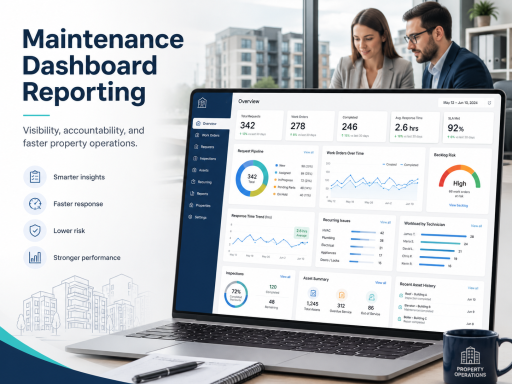
Measurement must be available to managers and operations leaders, not buried in manual spreadsheets. Reporting access should allow leaders to see response time, completion trends, recurring issues, and workload distribution—while keeping execution views focused for staff. This is best achieved with dedicated maintenance dashboards and reporting that reflect portfolio scope and role responsibilities.
Properties/Units ↔ Assets ↔ Reporting: use permissions to make lifecycle decisions reliable
Repeat work is often an asset story, not a ticket story. Without asset context, teams repeatedly diagnose the same equipment, misjudge replacement timing, and lose continuity when staff changes. A mature access model allows the right roles to view asset history and installation context while protecting governance.
Linking work history to lifecycle information makes reporting more actionable: you can distinguish “one-off incidents” from chronic failures that justify replacement planning. This is why asset visibility—implemented with sensible access boundaries—pairs effectively with asset installation records.
Resident experience: limit noise, increase speed, keep accountability
Residents want one thing: timely resolution with predictable communication. A role-based system supports this by reducing internal ambiguity and ensuring requests enter a controlled workflow from the beginning. When residents submit requests through a structured channel, managers can approve quickly, staff can execute with clarity, and inspections can validate outcomes where needed.
This approach starts with clean intake through a dedicated resident maintenance requests portal, ensuring each issue is captured consistently and routed into governance rather than scattered across inboxes.
Implementation checklist: a practical permission model to adopt
- Define roles: property manager, maintenance staff, inspector, administrator (then add specialty roles only if necessary).
- Assign scope: which properties/buildings/units each user can view and act on.
- Separate execution from verification: staff complete work; inspectors verify; managers govern outcomes.
- Standardize closure rights: limit who can close work and require consistent completion documentation.
- Protect reporting integrity: ensure managers can access performance dashboards across their scope without manual extraction.
- Review quarterly: permissions drift over time; routine audits preserve governance and scale.
The goal is operational simplicity: fewer workarounds, fewer bottlenecks, and a reliable history of who did what, when, and where.
Next step: standardize roles, then centralize the workflow
If your team is still coordinating maintenance across disconnected tools, start with role clarity and scope boundaries. From there, centralize the workflow so requests, approvals, execution, inspections, assets, and reporting operate as one system.
For implementation and packaging options, review TaskEstate pricing to choose the best fit for your portfolio size and operational needs.
FAQ
What is the biggest permission mistake in property maintenance operations?
Letting too many users close or override work order status without standards. It degrades data integrity and makes reporting unreliable, which then forces teams back into manual tracking.
Should inspectors have the same permissions as maintenance staff?
Typically no. Inspection is a verification function. Inspectors should be able to document findings and trigger follow-up work, but they should not be able to rewrite execution history in ways that undermine accountability.
How do role-based permissions improve response time?
They remove ambiguity and bottlenecks. When authority is clear—who approves, who assigns, who executes, who verifies—work moves through a predictable pipeline instead of stalling in email threads or informal coordination.